





Scroll through any skincare shelf, Instagram reel, or dermat's recommendation list, and two ingredients keep showing up for dark spots: tranexamic acid and vitamin C serum. Both claim to fade pigmentation. Both are backed by real science. But for Indian skin — which is more melanin-rich, more prone to post-acne marks, and constantly dealing with heat, humidity, and pollution — the two don't perform the same way.
So which one should you actually be using? Let's break it down properly.
What Is Tranexamic Acid and How Does It Fade Dark Spots?
Tranexamic acid works by interrupting the communication between skin cells that triggers excess melanin production. In simple terms, it calms down the "panic signal" your skin sends after inflammation (like a breakout, sun exposure, or irritation) — the exact signal that leads to dark spots and uneven tone.
This makes it especially effective for Post-Inflammatory Hyperpigmentation (PIH) — the dark marks left behind after acne — which is extremely common in Indian skin due to higher melanin activity. Tranexamic acid is also considered one of the more stable and gentle brightening actives, meaning it doesn't typically cause the irritation or sun sensitivity that some other actives do.
If you want the full science behind it, we've broken it down in detail here: What Is Tranexamic Acid? The Complete Guide for Indian Skin.
What Is Vitamin C and How Does It Fade Dark Spots?
Vitamin C is an antioxidant that works differently — it blocks the enzyme (tyrosinase) responsible for melanin production, while also fighting free radical damage from sun and pollution. This is why vitamin C is often recommended for brightening and preventing future dark spots, not just fading existing ones.
The catch? Vitamin C is notoriously unstable. It oxidizes quickly when exposed to air, heat, and sunlight — turning that bright orange-brown color you might have seen happen to an old bottle. In India's climate, where summers are intense and humidity is high for most of the year, a poorly formulated or improperly stored bottle can lose potency fast, or worse, irritate the skin instead of brightening it.
Tranexamic Acid vs Vitamin C: Side-by-Side Comparison
|
Factor |
Tranexamic Acid |
Vitamin C |
|
Best For |
Post-acne marks, PIH, melasma |
General brightening, dullness, prevention |
|
Mechanism |
Blocks melanin signal transfer |
Blocks melanin-producing enzyme + antioxidant |
|
Stability in Heat & Humidity |
Highly stable |
Oxidizes easily, less stable |
|
Irritation Risk |
Low, well-tolerated |
Can irritate sensitive/acne-prone skin at high %s |
|
Sun Sensitivity |
Minimal |
Can slightly increase sensitivity |
|
Visible Results |
6–8 weeks |
8–12 weeks |
|
Works Well With |
Niacinamide, Azelaic Acid |
Vitamin E, Ferulic Acid |
Which One Actually Works Better for Indian Skin?
For Indian skin specifically — melanin-rich, acne-prone, and living through humid, high-heat conditions most of the year — tranexamic acid usually has the edge for one simple reason: predictability. It stays stable in Indian weather, doesn't oxidize on your bathroom shelf, and is far less likely to trigger irritation on already-inflamed, acne-prone skin.
Vitamin C isn't a bad ingredient — it's just harder to get right in a hot, humid climate, and more likely to sting if your skin barrier is already compromised from active breakouts.
This is exactly why tranexamic acid is often paired with niacinamide — a combination that fades marks while also calming inflammation and strengthening the skin barrier at the same time. We've gone deeper into this ingredient pairing here: Niacinamide & Azelaic Acid Serum: Benefits for Acne & Dark Spots.
Can You Use Tranexamic Acid and Vitamin C Together?
Yes, but with a little planning. Since vitamin C is best used in the morning (for antioxidant protection through the day) and tranexamic acid works well at night, most dermatologists suggest splitting them across AM and PM rather than layering both at once — this reduces the chance of irritation while still getting the benefits of each.
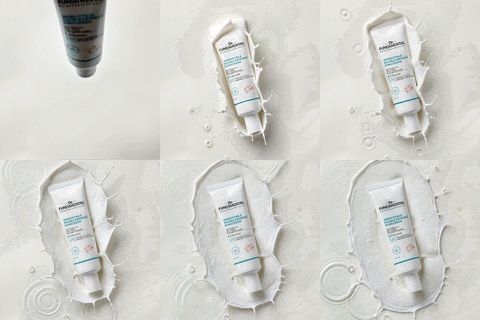
Why Dr. Fundamental's N0.3 Clarifying Face Serum Is a Smarter Pick for Indian Skin
Instead of choosing between the two and hoping it suits your skin, the N0.3 Clarifying Face Serum combines 4% Tranexamic Acid with 10% Niacinamide — built specifically for acne-prone, melanin-rich Indian skin. It's formulated as a genuine blemish serum, meaning it doesn't just brighten — it actively targets active breakouts, post-acne marks, and uneven tone together, without the oxidation or irritation issues that vitamin C can bring in Indian heat.
It's non-comedogenic, fragrance-free, and dermatologically tested, with most users seeing visible fading of dark spots and improved clarity within 6–8 weeks of consistent use — making it a genuine serum for clear skin rather than just another brightening trend.
To see exactly where this fits into your morning and night skincare steps, check out our Complete AM & PM Routine for Oily Acne-Prone Skin in India.