



The Squeaky-Clean Trap Nobody Warned You About
If you have oily, acne-prone skin, your first instinct is probably to reach for the strongest acne face wash you can find and scrub your face three, maybe four times a day. Strip every drop of oil. Wash until your skin feels tight and squeaky-clean. Because if oil and bacteria are behind your breakouts, getting rid of them around the clock should fix things — that's the logic, anyway.
But here's what's actually happening.
That tight, dry sensation you feel right after washing? That's not your skin getting cleaner. That's your skin barrier breaking down. What you're feeling is the loss of your skin's natural oils and the outer lipid layer that keeps everything protected and balanced. Skin that's been cleansed correctly doesn't feel stretched or uncomfortable — it feels settled and calm. The squeaky feeling so many oily-skin users chase is actually a warning sign, not a green flag. And the more aggressively you chase it, the harder your skin has to work to recover from it.
Here's the uncomfortable truth: if your cleansing routine is aggressive, it may be the very reason your acne keeps coming back.
What Actually Happens When You Over-Cleanse
Your skin is not just a surface to be scrubbed. It's a living organ with its own ecosystem — an acid mantle, a microbiome, and a lipid barrier that work together to keep your skin balanced, hydrated, and protected.
Your skin's acid mantle sits at around pH 4.5–5.5. When a cleanser is too alkaline or overloaded with strong surfactants, it raises this pH, strips the protective lipids, and weakens the cohesion between skin cells — leaving your face feeling tight, itchy, and squeaky after rinsing.
Then the rebound kicks in.
When you strip your skin's natural oils through over-cleansing, the oil glands go into overdrive to compensate. The result? Oily skin becomes shinier and experiences even more breakouts — the exact opposite of what you were going for.
This is called reactive seborrhea, and it's a vicious cycle that keeps millions of people trapped: wash face → skin feels stripped → oil glands panic → more oil → more breakouts → wash face again.
The Science of Barrier Damage and Acne
Here's what makes this especially frustrating: a damaged skin barrier triggers an inflammatory response. Your skin goes into repair mode, ramping up oil production and increasing cell turnover — both of which contribute directly to clogged pores and breakouts. So damaging your barrier in an attempt to fight acne actually accelerates the very processes that cause it.
Let's break down the chain of events:
|
What You Do |
What Your Skin Does |
|
Over-wash with harsh cleanser |
pH rises, barrier lipids stripped |
|
Skin feels tight and "clean" |
Moisture barrier compromised |
|
Sebaceous glands detect dryness |
Oil production surges (reactive seborrhea) |
|
Excess oil clogs pores |
New breakouts form |
|
You wash more aggressively |
The cycle continues |
The irony is brutal. The more you fight your skin, the more your skin fights back.
5 Signs You're Over-Cleansing (And Blaming It on Acne)
Most people don't realise they're over-cleansing because the damage feels like it's coming from somewhere else. Watch out for these warning signs:
1. Your face feels tight within minutes of washing
A correctly cleansed face should feel balanced and comfortable. Tightness means moisture has been stripped, not just oil.
2. You're shiny by mid-morning, even after washing at 7 AM
This is reactive seborrhea in action. Your oil glands are compensating for what was stripped.
3. You're getting breakouts in new areas
Over-cleansing can trigger inflammation across the face — not just in your usual T-zone. New breakouts popping up around the cheeks or jaw are a red flag.
4. Your skin looks dull or feels rough
Over-exfoliation and excessive cleansing can disrupt your skin's protective barrier, causing dryness, inflammation, and irritation — all of which can lead to more breakouts, not fewer.
5. Your acne treatments seem to stop working
When the barrier is compromised, even good active ingredients can't penetrate correctly. They either sit on the surface or cause irritation rather than treatment.
What Dermatologists Actually Recommend
Dermatologists recommend cleansing no more than twice a day — once in the morning and once at night — and after sweating. While washing, resist the temptation to scrub your skin, even to remove makeup. Scrubbing irritates the skin, which can make acne look and feel worse.
This advice holds true whether your skin is oily, combination, or acne-prone. Twice a day is the ceiling, not a minimum target.
Beyond frequency, the choice of cleanser matters just as much. Dermatologists consistently recommend:
- A gentle cleanser for oily skin that removes excess oil and impurities without stripping the skin's natural moisture film
- A non-comedogenic formula so the cleanser itself doesn't contribute to clogged pores
- Fragrance-free options, since fragrance is among the most common triggers for skin irritation and barrier compromise
- Lukewarm water, not hot — hot water dissolves barrier lipids faster and makes stripping worse
The correct layering order after cleansing is: toner, serum, moisturizer, then sunscreen. The sequence ensures that lighter, active products absorb into skin first, while heavier products sit on top to seal in hydration.
And here's something many people skip entirely: moisturiser. Even for oily skin.
Applying moisturiser after cleansing is still important for oily skin — it's about striking a balance between having too much oil and maintaining your skin's natural moisture. Look for oil-free, non-comedogenic moisturisers that hydrate without clogging pores.
The Right Ingredients in a Cleanser for Oily, Acne-Prone Skin
Not all acne face washes are created equal. The ingredient list tells you whether your cleanser is going to help or quietly sabotage your skin.
What to look for:
Benzoyl Peroxide (2.5%) — The gold standard for bacterial acne. At 2.5%, it's clinically effective at eliminating acne-causing bacteria without the excessive dryness that comes with higher concentrations like 5% or 10%. A benzoyl peroxide-based cleanser for oily skin not only kills acne-causing bacteria and detoxifies pores but also helps balance the skin's sebum levels without irritating or drying out the skin.
Salicylic Acid (low concentration) — A BHA that works inside the pore. It dissolves the keratin plugs responsible for blackheads and whiteheads, keeping pores clear between washes.
Panthenol (Vitamin B5) — A skin-conditioning ingredient that replenishes moisture and supports barrier recovery. Its presence in an acne cleanser signals that the formula is designed to treat without stripping.
Allantoin — A soothing agent that helps calm redness and supports skin repair, important when activities are in the formula.
Hyaluronic Acid — Even in a rinse-off cleanser, hyaluronic acid helps maintain surface hydration and prevents the stripped sensation.
What to avoid:
- High concentrations of sulphates (especially SLS) — highly alkaline, strip the acid mantle
- Fragrances and essential oils — common irritants that trigger inflammatory responses
- Alcohol-based formulas marketed for "oil control" — these cause severe rebound oiliness
- Abrasive scrub particles — create micro-tears and worsen inflammation
Why a Mild Cleanser for Oily Skin Beats an Aggressive One — Every Time
Here's what the science and dermatologists both agree on: gentler is not weaker. A mild cleanser for oily skin that works with your barrier will outperform an aggressive one that works against it, every single time.
The key is to cleanse just enough to remove impurities without stripping away essential oils or damaging the skin barrier. When the barrier is intact, everything else you do for your acne — the treatments, the medications, the actives — works better.
Think of your skin barrier like a security system. A gentle, well-formulated cleanser for oily skin keeps the security system running. An aggressive one disables it, and suddenly every irritant, every bacteria, every environmental pollutant gets through unchallenged.
That's when acne becomes harder to control — not because you're not trying hard enough, but because your barrier can no longer help you fight back.
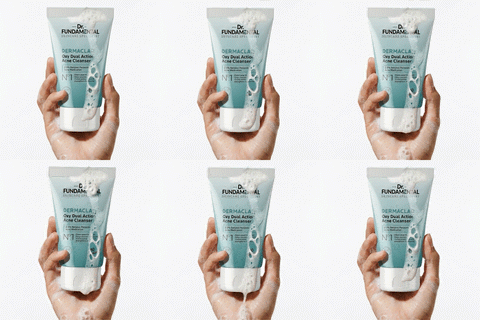
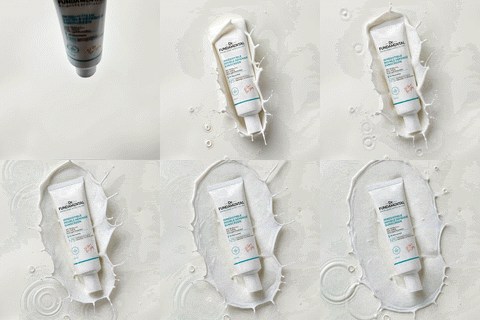
Introducing DR. Fundamental Dermaclar Oxy Acne Cleanser — Built Around This Exact Problem
Most acne face washes in the market choose one of two things: they're either effective but drying, or gentle but passive. DR. Fundamental's Dermaclar Oxy Acne Cleanser was formulated to do both at once.
At the heart of it is 2.5% Encapsulated Benzoyl Peroxide — the same concentration dermatologists recommend as the sweet spot between efficacy and tolerability. The encapsulated delivery system releases the active slowly and evenly on skin contact, which means it works where it's needed without flooding the skin with a harsh burst of the ingredient.
The result? 93% of acne-causing bacteria are eliminated within just one minute of use. 97% of users reported visible reduction in acne and fewer new breakouts. And critically — 84% found the formula felt gentle and non-drying, which is almost unheard of for a benzoyl peroxide-based cleanser.
What makes this a true gentle cleanser for oily skin rather than just a marketing claim is the supporting formula. Panthenol and Allantoin actively soothe and repair while Benzoyl Peroxide treats. Hyaluronic Acid maintains hydration through the cleanse. Decyl Glucoside and Cocamidopropyl Betaine — mild surfactants — lift oil and impurities without spiking skin pH.
The formula is also:
- Fragrance-free — no hidden irritants triggering unnecessary inflammation
- Non-comedogenic — the cleanser won't be the reason new pores clog
- Dermatologically tested — including for sensitive and barrier-compromised skin
This is exactly what a mild cleanser for oily skin should look like in 2025 and beyond: therapeutic without being traumatic, effective without being aggressive.
How to Use It — Without Over-Cleansing
Even the best cleanser delivers poor results if it's used incorrectly. Here's the DR. Fundamental-recommended protocol:
Step 1: Wet your face with lukewarm water — not hot, not cold.
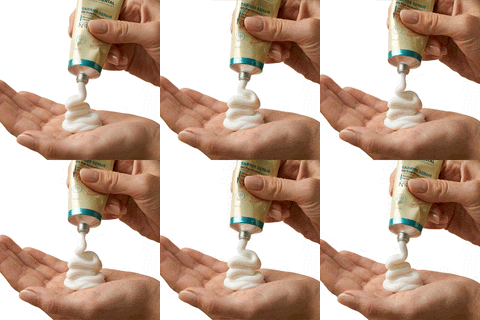
Step 2: Dispense a small amount of the Dermaclar Oxy Acne Cleanser and gently massage it onto damp skin using your fingertips in soft circular motions. No rubbing, no scrubbing.
Step 3: Leave it on for 2 minutes. This is important — the encapsulated Benzoyl Peroxide needs brief contact time to release and work on bacteria inside the pore.
Step 4: Rinse thoroughly with lukewarm water and pat dry with a clean towel.
Step 5: Follow immediately with a serum or moisturiser. Don't leave active-cleansed skin bare — it's primed to absorb what comes next, and leaving it without hydration undoes the barrier-protective work of the cleanser.
Use it up to twice daily depending on your skin's tolerance. If you're new to Benzoyl Peroxide, start with once daily in the evening and build up.
The Bottom Line: Stop Fighting Your Skin, Start Working With It
Over-cleansing for oily, acne-prone skin is one of the most counterproductive habits in skincare — and the most underdiagnosed. The evidence is consistent across dermatology: when your barrier is intact, everything you do for your acne works better. Stop trying to scrub your acne away. Start working with your skin instead of against it.
The shift from an aggressive, strip-everything approach to a targeted, barrier-conscious one is not a compromise. It's an upgrade.
A well-formulated gentle cleanser for oily skin — one that carries therapeutic actives like Benzoyl Peroxide without sacrificing barrier integrity — is not a lesser option. It's the smarter, science-backed one.
Your skin isn't the enemy. Your cleanser might be.