





If you have ever stood in front of a mirror counting stubborn dark spots, uneven patches, or leftover acne marks that just refuse to go away despite months of trying every brightening cream you could find — this article is written for you.
Indian skin is incredibly beautiful, but it comes with its own set of challenges. Our melanin-rich complexion, combined with year-round sun exposure, high humidity, dust, and pollution, makes us more prone to hyperpigmentation, post-acne marks, and melasma than many other skin types globally. For decades, the go-to answers were Vitamin C, kojic acid, or the controversial hydroquinone. But there is a newer, gentler, and frankly more impressive ingredient that dermatologists across India are now recommending — Tranexamic Acid.
And when you combine it with 10% Niacinamide? That is where things get really exciting.
So, What Exactly Is Tranexamic Acid?
Tranexamic Acid, often abbreviated as TXA, is a synthetic derivative of lysine — an essential amino acid that plays a role in collagen production and protein building in the body. In its original avatar, it was used in medicine to control heavy bleeding, commonly prescribed by surgeons and gynaecologists. But somewhere along the line, dermatologists began noticing something remarkable: patients taking it orally were showing significant improvement in their pigmentation and melasma.
That discovery opened the door to topical formulations — serums, creams, and toners — that deliver tranexamic acid benefits directly to the skin without the risks associated with oral doses.
What makes it work so differently from other brightening ingredients? The answer lies in how deeply it targets the cause of pigmentation, not just the surface symptoms.
How Tranexamic Acid Actually Works on Indian Skin
When your skin is exposed to the sun, experiences inflammation from a pimple, or goes through hormonal fluctuations, it sends out signals that trigger melanocytes (the cells responsible for producing melanin) to go into overdrive. This overproduction of melanin is exactly what causes the dark spots, patches, and uneven tone that so many of us deal with.
Tranexamic Acid steps in and disrupts this communication. It blocks the pathway between keratinocytes (surface skin cells) and melanocytes, essentially telling your skin to calm down the melanin production. It also reduces inflammation-induced pigmentation — which is why it works so brilliantly on post-acne marks, not just sun spots.
Here is what makes this particularly relevant for Indian skin:
- Sun damage is relentless in India. Whether you live in Rajasthan where the sun is aggressive, or Mumbai where humidity amplifies UV impact, your skin is constantly battling pigmentation triggers.
- Post-acne marks (PIH) are extremely common. Brown and dark skins are far more susceptible to post-inflammatory hyperpigmentation because our melanocytes are more reactive.
- Melasma is widespread. Hormonal changes from pregnancy, stress, or even certain medications can trigger those stubborn cheek patches that seem impossible to fade.
Tranexamic Acid addresses all three of these root causes at once — and it does so without irritating or sensitising the skin like many exfoliating acids tend to do.
The Science Behind the Results — What Research Actually Shows
If you are someone who needs numbers before trusting a product, here is what clinical data tells us.
Studies have shown that a 3% concentration of Tranexamic Acid reduces hyperpigmentation significantly within eight weeks of consistent use. In comparative research, it has performed on par with hydroquinone — the gold standard in pigmentation treatment — but without the dryness, peeling, and rebound hyperpigmentation that hydroquinone is notorious for.
Additionally, a 2015 study found that Tranexamic Acid actually improves skin barrier function and reduces skin irritation. This is almost the opposite of what most active brightening ingredients do. While AHAs and BHAs exfoliate and temporarily weaken the skin barrier, TXA strengthens it. For Indian skin that is already dealing with pollution, heat, and sun damage, this is a genuinely rare and valuable quality.
Enter Niacinamide: The Ultimate Partner
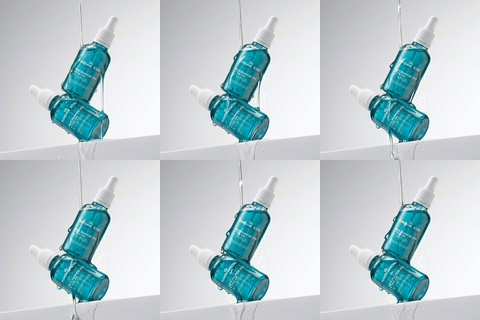
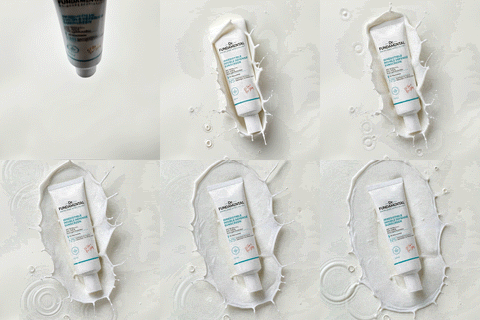
Now, Tranexamic Acid working alone is impressive. But when it is formulated alongside 10% Niacinamide, the results move to a completely different level. This is the exact combination found in Dr. Fundamental's 4% Tranexamic Acid + 10% Niacinamide Clarifying Face Serum — and understanding why these two work together helps you appreciate what makes this formulation stand out.
Niacinamide, also known as Vitamin B3, is one of the most versatile and well-researched skincare ingredients available today. It works through a completely different mechanism than Tranexamic Acid. While TXA blocks the signal that triggers melanin production, Niacinamide inhibits the transfer of melanin to the surface of your skin. Together, they tackle pigmentation from two separate angles simultaneously.
Here is a breakdown of what niacinamide serum benefits bring to the table when combined with TXA:
1. Reduces Post-Acne Marks More Effectively
Niacinamide is clinically proven to reduce post-inflammatory hyperpigmentation (PIH) — the brown or reddish marks left behind after a breakout. For those searching for a serum for acne marks, this combination is one of the most complete answers available because it both calms active inflammation and prevents future marks from deepening.
2. Controls Excess Oil Production
Indian skin, particularly in humid summers, tends to produce excess sebum. Niacinamide regulates oil production at the sebaceous gland level, making it an excellent choice for anyone with oily or combination skin dealing with both acne and pigmentation simultaneously.
3. Minimises the Appearance of Pores
One of the most visible niacinamide serum benefits is pore refinement. With consistent use, pores look smaller, skin texture becomes smoother, and the overall appearance of the face feels more refined.
4. Strengthens the Skin Barrier
At 10% concentration, Niacinamide actively helps the skin produce ceramides — the lipids that form the protective outer layer of your skin. A stronger barrier means less sensitivity, better moisture retention, and improved resilience against environmental damage.
5. Soothes Redness and Inflammation
For those who experience redness along with pigmentation, Niacinamide's anti-inflammatory properties calm the skin and reduce visible redness — making it suitable for even reactive or sensitive skin types.
Why This Serum Is Built Specifically for Indian Skin
Most international skincare brands formulate for Caucasian skin — skin that has less reactive melanocytes and fewer concerns around post-inflammatory hyperpigmentation. When Indian consumers use these products, the results are often underwhelming.
Dr. Fundamental's 4% Tranexamic Acid + 10% Niacinamide Clarifying Face Serum addresses this gap. Here is why the formulation makes sense for our skin specifically:
- 4% Tranexamic Acid is a clinically meaningful concentration — strong enough to produce visible brightening results without irritating skin that is already dealing with sun stress.
- 10% Niacinamide is the concentration backed by the most robust research for tackling stubborn pigmentation, acne marks, and uneven tone. It is potent but remarkably well-tolerated across all Indian skin types — dry, oily, combination, and sensitive.
- The clarifying formulation means it is designed to work as a serum for clear skin — not just spot treatment, but whole-face clarity over consistent use.
How to Use It Correctly in Your Skincare Routine
Getting the right results from a powerful serum depends as much on how you use it as on what it contains. Here is a routine that works well for Indian skin:
Morning Routine:
- Gentle face wash suited to your skin type
- Apply 3–4 drops of the Dr. Fundamental TXA + Niacinamide serum across your face and neck
- Follow with a lightweight moisturiser
- Finish with a broad-spectrum SPF 30 or higher — this is non-negotiable when using any brightening ingredient
Night Routine:
- Double cleanse if you have worn sunscreen or makeup
- Apply the serum again — nighttime application allows active ingredients to work undisturbed during cell renewal cycles
- Lock in with a slightly richer moisturiser
If you are a beginner with actives: Start with once-daily use for the first 2 weeks, then build up to twice daily as your skin adjusts.
What Results Should You Realistically Expect — and When?
Patience is the most underrated skincare ingredient. Here is a realistic timeline:
- Weeks 1–2: Skin may feel slightly more balanced; oil control becomes noticeable
- Weeks 4–6: Acne marks begin visibly lightening; overall skin tone looks more even
- Weeks 8–12: Significant reduction in hyperpigmentation, melasma patches, and sun damage; skin appears clearer and more radiant
For those using it as a serum for clear skin with no major pigmentation concerns, you will likely notice texture refinement and a healthy glow within the first month itself.
Ingredients That Work Well With This Combination
One of the great strengths of both Tranexamic Acid and Niacinamide is that they are exceptionally friendly with other ingredients:
- Hyaluronic Acid: Pairs beautifully for added hydration without interfering with brightening action
- Vitamin C (in the AM): Enhances antioxidant protection against UV-triggered pigmentation
- Retinol (in the PM, on alternate nights): For deeper skin renewal — but introduce slowly and not simultaneously
- SPF: Always, always, always. Every single day. Brightening without sun protection is like mopping the floor with the tap still running.
Is It Safe? Who Should and Should Not Use It?
Tranexamic Acid and Niacinamide together are considered among the safest brightening combinations available for topical use. They are:
✔ Safe for all skin tones, including dark Indian skin tones
✔ Non-photosensitising (unlike AHAs and retinol)
✔ Suitable for sensitive and reactive skin
✔ Safe for pregnant women in topical forms (though always consult your doctor)
✔ Appropriate for both morning and evening use
Those with extremely reactive skin should still do a patch test on the inner wrist before applying to the full face. And while rare, mild redness or tingling in the first few uses is normal as the skin adjusts.
Final Word: Why This Combination Deserves a Place in Every Indian Skincare Routine
We live in a country where the sun is generous, pollution is relentless, and breakouts leave their mark — sometimes literally. Indian skin has been underserved by global skincare for too long. The growing wave of science-backed, India-first formulations is finally changing that.
The combination of tranexamic acid benefits and niacinamide serum benefits in a single, well-dosed serum is not just a trend — it is a clinically sound answer to the most common skin concerns Indian skin faces every day. Whether you are fighting serum for acne marks, chasing that serum for clear skin, or simply trying to wake up to a more even, glowing face every morning, this is the kind of formulation built to deliver on its promises.
Dr. Fundamental's 4% Tranexamic Acid + 10% Niacinamide Clarifying Face Serum gives your skin exactly what it needs — targeted, intelligent, and designed with Indian skin in mind.