




You wash your face twice a day. You avoid oily food. You've tried every acne product on the shelf. Yet the breakouts keep coming back — sometimes worse than before. Sound familiar?
Here's something most people never consider: your face wash could actually be the root cause of your persistent acne. Not because it's not cleaning enough, but because it's cleaning too aggressively — and in doing so, it's dismantling the very defence system your skin needs to stay clear.
This article breaks down exactly how the skin barrier and acne are connected, what happens when you use the wrong cleanser, and what to look for in a mild cleanser for oily skin that actually works with your skin instead of against it.
What Is the Skin Barrier, and Why Should You Care?
Think of your skin barrier as a brick wall. The "bricks" are your skin cells (corneocytes), and the "mortar" holding them together is a blend of natural lipids — ceramides, fatty acids, and cholesterol. This structure sits at the outermost layer of your skin, and its job is to:
- Lock in moisture and prevent water loss
- Block out bacteria, pollutants, and allergens
- Regulate your skin's natural oil production
- Maintain the slightly acidic pH (around 4.5–5.5) that keeps bad bacteria in check
When this barrier is healthy and intact, it creates an environment where skin can regulate itself. When it's damaged, everything falls apart — including your ability to control acne.
The Vicious Cycle: How a Harsh Cleanser Triggers More Breakouts
Here's what nobody tells you when you're standing in the skincare aisle looking for a cleanser for oily skin: stripping your skin of oil does not prevent acne. In fact, it often causes more of it.
This is how the cycle plays out:
Step 1 — You use a harsh, high-foaming face wash. It removes every trace of oil from your face. Your skin feels "squeaky clean."
Step 2 — Your skin barrier is disrupted. The natural lipids that form the protective layer are washed away along with excess sebum.
Step 3 — Your sebaceous glands panic. They interpret the dryness as damage and respond by producing more oil to compensate. This is called rebound oiliness.
Step 4 — Excess oil + compromised barrier = more acne. With the barrier weakened, bacteria find it easier to penetrate, inflammation rises, and breakouts follow — often more severe than before.
This pattern explains why so many people with oily skin describe their skin as simultaneously greasy and dehydrated. It's not a contradiction; it's a direct consequence of barrier damage.
Signs Your Face Wash Is Damaging Your Skin Barrier
Before switching your cleanser, it helps to identify whether yours is already causing harm. Watch for these signals:
|
Warning Sign |
What It Means |
|
Skin feels tight or "squeaky" after washing |
Natural lipids have been stripped |
|
Skin becomes oily again within 2–3 hours |
Rebound sebum production is happening |
|
Breakouts worsen after a new cleanser |
Barrier is compromised, inflammation is high |
|
Redness, flaking, or stinging post-wash |
pH disruption and lipid loss |
|
Skin looks dull and congested |
Barrier is too damaged to regulate turnover |
If two or more of these apply to you, your current face wash is likely working against you.
The Biggest Mistakes People with Oily Skin Make When Choosing a Cleanser
Mistake 1: Choosing a face wash because it lathers a lot.
Heavy foaming usually means high concentrations of sulfates like SLS (Sodium Lauryl Sulfate). These are effective detergents — so effective that they strip away protective lipids along with dirt and oil. For acne-prone skin, this is a recipe for barrier destruction.
Mistake 2: Thinking more cleansing = clearer skin.
Washing your face three or four times a day does more harm than good. It depletes the skin's natural moisture factor, raises the surface pH, and leaves skin vulnerable to bacterial invasion. Twice daily is the gold standard, and even that should be done gently.
Mistake 3: Picking high-concentration actives without considering the formula.
A 10% benzoyl peroxide face wash sounds powerful, but the concentration is often far beyond what the skin needs — and significantly raises the risk of barrier disruption, dryness, and irritation that worsens acne over time.
Mistake 4: Skipping moisturiser because skin feels oily.
Oily skin can still be dehydrated. Skipping moisturiser after cleansing leaves the barrier even more exposed, triggering the oil-overproduction cycle all over again.
What to Actually Look for in a Cleanser for Oily, Acne-Prone Skin
The modern dermatological approach to acne has shifted considerably. Rather than punishing the skin into submission, the focus is now on maintaining barrier health while treating the breakout. Here's what a genuinely effective cleanser for oily skin should do:
✓ Maintain skin pH around 4.5–5.5
Alkaline cleansers disrupt the acid mantle and allow acne-causing bacteria to thrive. Opt for pH-balanced, low-foaming formulas.
✓ Use actives at clinically effective — not excessive — concentrations
Research shows that 2.5% benzoyl peroxide is as effective as 5–10% concentrations for killing acne-causing bacteria, with significantly less barrier irritation. Similarly, salicylic acid at 0.5–2% is effective for unclogging pores without aggressive over-exfoliation.
✓ Include barrier-supportive ingredients alongside the actives
A cleanser that treats acne without including soothing or hydrating agents is an incomplete formula. Ingredients like panthenol (Vitamin B5), allantoin, hyaluronic acid, and glycerin help counteract the drying effect of actives and keep the barrier intact during treatment.
✓ Be fragrance-free and non-comedogenic
Fragrances are a leading cause of contact dermatitis and skin sensitisation, particularly in acne-prone individuals. Non-comedogenic formulas ensure the product itself doesn't contribute to clogged pores.
Why an Oil Cleanser for Oily Skin Might Actually Belong in Your Routine
It sounds counterintuitive, but an oil cleanser for oily skin — used as a first step in a double cleanse — can actually be beneficial. Oil cleansing follows the chemistry principle of "like dissolves like": an oil-based cleanser effectively breaks down sunscreen, makeup, and excess sebum without disturbing the skin's water content or natural lipids. When rinsed off, it takes the surface-level impurities with it, leaving the skin ready for a gentler second cleanse with an active-based formula. If you wear heavy sunscreen daily (and you should), a double cleanse makes sense.
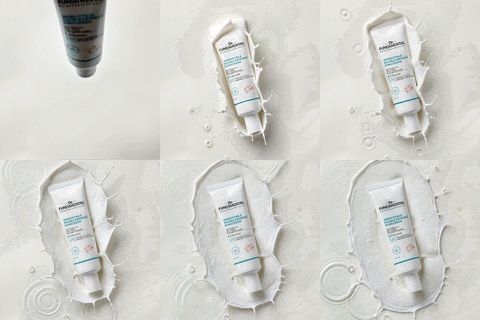
How DR. Fundamental's Dermaclar Oxy Acne Cleanser Gets the Balance Right
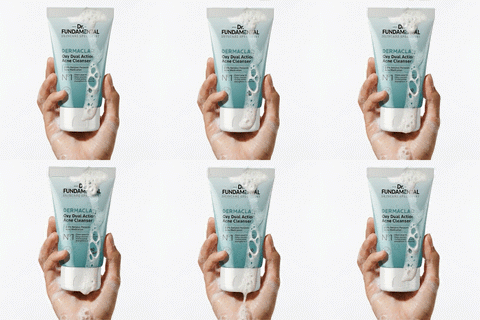
Most acne cleansers make you choose between being effective and being gentle. DR. Fundamental's Dermaclar Oxy Acne Cleanser was formulated to do both — and the clinical data backs it up.
Here's what makes it a genuinely intelligent mild cleanser for oily skin:
2.5% Encapsulated Benzoyl Peroxide — At this concentration, it eliminates 93% of acne-causing bacteria within just one minute of contact, without the aggressive drying effect associated with higher-concentration formulas. The encapsulation matters too: it allows the active ingredient to be released slowly and evenly on skin contact, reducing the irritation risk compared to standard benzoyl peroxide delivery.
Salicylic Acid (low concentration) — Works alongside the benzoyl peroxide to address congested pores. Salicylic acid is oil-soluble, meaning it penetrates into the pore lining itself to dissolve the buildup of dead skin cells and excess sebum that leads to blackheads and whiteheads.
Panthenol + Allantoin — These are the barrier-repair workhorses. Panthenol (provitamin B5) draws moisture into the skin, while allantoin soothes and promotes cell renewal. Both actively counteract the potential drying effect of the benzoyl peroxide.
Hyaluronic Acid — Provides lightweight hydration that keeps the skin from feeling tight or stripped after washing, a common complaint with most oil cleanser for oily skin alternatives that skew too drying.
Decyl Glucoside + Cocamidopropyl Betaine — These are gentle, plant-derived surfactants that create a mild lather without the aggressive stripping action of sulfates. They clean effectively without destroying the barrier.
The result is a formula that's dermatologically tested, fragrance-free, non-comedogenic, and sensitive-skin friendly — but also clinically active. In trials, 97% of users noticed a visible reduction in acne and fewer new breakouts, and 79% reported a stronger, healthier skin barrier with continued use.
How to use it: Massage a small amount onto damp skin, leave it on for two minutes to let the actives work, then rinse with lukewarm water. Always follow with a serum or moisturiser to lock in hydration and support barrier repair. Use once or twice daily, depending on your skin's tolerance.
Building a Barrier-First Acne Routine
Your cleanser is the foundation, but it works best as part of a layered, barrier-conscious routine:
|
Step |
Purpose |
What to Look For |
|
Cleanse |
Remove bacteria, oil, impurities |
Gentle actives, no sulfates, pH-balanced |
|
Treat |
Target active acne, congestion, marks |
Salicylic acid, niacinamide, azelaic acid |
|
Repair |
Rebuild and seal the barrier |
Ceramides, panthenol, tranexamic acid |
|
Protect |
Block UV damage that worsens post-acne marks |
Broad-spectrum SPF 50 PA++++ |
Skipping any layer — especially moisturiser and SPF — undoes the work of your cleanser and keeps the barrier in a constant state of recovery.
The Takeaway
Acne is not a sign that your skin is dirty. More often, it is a sign that your skin's defence system is under stress — and the wrong face wash is frequently the biggest culprit. The path to clearer skin is not about cleaning harder; it is about cleaning smarter.
A mild cleanser for oily skin that respects your barrier, delivers activities at the right concentration, and supports hydration is not a compromise. It's the most effective strategy available — backed by both dermatological science and real-world results.
Your skin doesn't need to be punished to be clear. It needs to be protected.