





Okay, let's have an honest conversation. The kind you'd have with a friend who actually knows skincare — not the kind where someone just sells you something and wishes you luck.
You've probably been down the dark spot rabbit hole. You bought a Vitamin C serum because every influencer on the planet swore by it. Maybe it worked a little. Maybe it oxidised before you even hit the halfway mark. Maybe your skin threw a fit and got more irritated than before. And now you're hearing about Tranexamic Acid and wondering — is this the thing that's actually going to work for my skin?
Let's break it all down, because for Indian skin specifically, this question matters more than most people realise.
Why Dark Spots Hit Differently on Indian Skin
Here's the thing nobody really explains — Indian skin sits higher on the Fitzpatrick scale (types IV to VI), which means our skin naturally produces more melanin. That's beautiful, truly. But it also means that any time our skin goes through stress — a pimple, a rash, sun exposure, even a minor cut — melanin rushes to that spot like an overprotective aunty. The result? Dark marks that stick around for months, or sometimes years, long after the original problem has healed.
Pigmentation in Indian skin is triggered by multiple factors — harsh UV exposure in Indian summers causes UV-triggered melanin production, hormonal changes like PCOS and pregnancy can trigger melasma, and post-inflammatory hyperpigmentation (PIH) from acne scars or even minor cuts leaves behind long-lasting dark marks.
So when you're choosing a serum for acne marks, you're not just picking a random brightening ingredient. You're choosing something that needs to understand the specific way your skin responds to inflammation and injury. That's the context. Now let's talk about the two ingredients that are dominating skincare conversations right now.
What Even Is Tranexamic Acid?
Don't let the name intimidate you — Tranexamic Acid (TXA) is not a traditional acid in the way Vitamin C or AHAs are. Despite its name, tranexamic acid is not an exfoliator. It is derived from essential amino acids and focuses on diminishing the appearance of dark spots rather than actively exfoliating the skin.
So what does it actually do? Tranexamic acid blocks the inflammatory signals that activate tyrosinase — the enzyme that converts tyrosine into melanin. This makes it effective for melasma, which is driven by inflammation and hormones.
In plain terms? It goes to the root of the problem. Instead of trying to scrub away pigmentation after it's already formed, TXA tells your skin to calm down before it even starts overproducing melanin. For Indian skin that's constantly being triggered by heat, hormones, and post-acne inflammation, that's a game-changer.
Tranexamic acid is generally compatible with all skin types, including sensitive skin. It can be safely used alongside other ingredients like niacinamide, hyaluronic acid, retinoids and Vitamin C.
And Vitamin C — Is It Actually Overrated?
No, and let's be fair here. Vitamin C is a legend for a reason. It's a powerful antioxidant, it protects against sun damage, it boosts collagen, and yes, it does help with brightening. If you want your skin to look radiant and glowy, Vitamin C delivers.
But — and this is a big but — it has its quirks. Vitamin C is famously unstable. It oxidises quickly when exposed to air and light, which means that half-used bottle sitting on your bathroom shelf might already be working against you (you know it's gone bad when it turns yellow-orange). It can also cause irritation, especially in higher concentrations, and for oily or acne-prone skin, some forms of Vitamin C can even trigger breakouts.
Vitamin C, glycolic acid, and niacinamide are multi-tasking ingredients, and their action on hyperpigmentation is secondary to their other benefits. On the other hand, tranexamic acid is more specific to treating hyperpigmentation — it interrupts melanin activity and synthesis, effectively fading dark marks.
So Vitamin C is a generalist. TXA is a specialist. That distinction matters when you have stubborn acne marks on Indian skin that simply refuse to budge.
Head-to-Head: Which One Is Actually Better for You?
Here's the honest comparison, and it really does depend on what problem you're trying to solve:
Choose Tranexamic Acid if:
- You're dealing with melasma or hormonal pigmentation that keeps coming back even after you treat it
- Your skin is on the sensitive side and gets irritated by stronger actives
- You have post-inflammatory hyperpigmentation (PIH) — those dark marks left behind by pimples
- You've tried Vitamin C before and it just didn't give you the results you wanted
Choose Vitamin C if:
- Your main concern is dullness and overall lack of radiance
- You want antioxidant protection from sun and pollution damage
- Your skin is not particularly sensitive and tolerates actives well
- You have mild, surface-level brightening needs rather than deep pigmentation
Tranexamic acid offers a gentle but powerful approach for deep pigmentation and melasma, while vitamin C serum is excellent for brightening and protecting the skin. For Indian skin, where pigmentation can be persistent, tranexamic acid serums provide a safe, effective, and dermatologist-recommended option.
The really good news? You don't have to pick just one. Vitamin C for dark spots works synergistically with tranexamic acid for comprehensive pigmentation treatment — you can apply vitamin C first, wait five minutes, then apply tranexamic acid. They work through entirely different pathways, so they don't compete — they complement.
But Wait — What About the Acne That's Causing the Dark Spots in the First Place?
Okay, here's where a lot of skincare conversations go wrong. Everyone's focused on fading dark spots, but nobody's asking: why do you keep getting new ones?
If you're getting recurring acne marks, it means the acne hasn't been properly controlled. And no amount of brightening serums is going to help long-term if you keep having breakouts that leave behind new pigmentation every few weeks. It's like mopping the floor with the tap still running.
This is exactly why, for acne-prone Indian skin, what you really need alongside any brightening ingredient is an anti acne face serum that tackles the root causes — excess oil, clogged pores, bacteria, and inflammation. Because when you stop the breakouts, you stop the cycle of new dark marks forming.
The Real Acne-Pigmentation Cycle and How to Break It
Here's how the cycle typically works for most Indian skin types, and why a single-ingredient approach rarely cuts it:
- Active acne forms due to clogged pores, excess sebum, and bacteria
- The inflammation from that pimple triggers melanin overproduction
- Even after the pimple heals, a dark mark (PIH) remains
- Sun exposure deepens that mark further
- New breakouts form, creating fresh marks before the old ones have even faded
To actually break this cycle, you need an approach that addresses all three stages simultaneously — clear the pore, fight the inflammation, and fade the mark. That's a tall order for one single ingredient, which is why multi-active serums have become the gold standard for skin that deals with acne scars and blackheads together.
What Ingredients Actually Work Together for Acne + Dark Spots?
The most effective combinations for Indian skin that's dealing with both active acne and post-acne pigmentation tend to include a mix of the following types of actives. These are ingredients that research and dermatologists consistently recommend for acne-prone South Asian skin:
- Salicylic Acid (BHA): This oil-soluble ingredient can penetrate deep into pores to dissolve the buildup that causes blackheads and whiteheads — particularly effective for oily skin types common in India's humid climate.
- Niacinamide: A multitasking superstar that regulates oil production, reduces inflammation, and helps fade post-acne marks — gentle enough for sensitive skin but powerful enough to make a real difference.
- Azelaic Acid: Provides gentle exfoliation whilst fighting bacteria — particularly good at addressing the redness and inflammation that often accompany breakouts.
What's remarkable about these three together is how well they divide responsibilities. Azelaic acid goes in and fights the battle — bacteria, inflammation, clogged pores — and niacinamide cleans up the aftermath: marks, oil, barrier damage. One is your warrior, the other is your healer. And salicylic acid keeps pores clear so the whole cycle gets interrupted at its starting point.
Meet the Dr. Fundamental Glass Skin Anti Acne Serum
Now, here's where things get really practical. Because understanding which ingredients work is great, but you also need a product that actually delivers them at effective concentrations — without irritating your skin or costing you a month's salary.
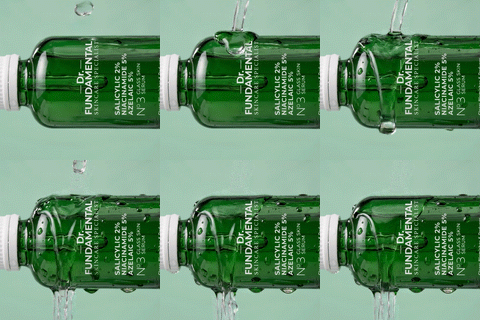
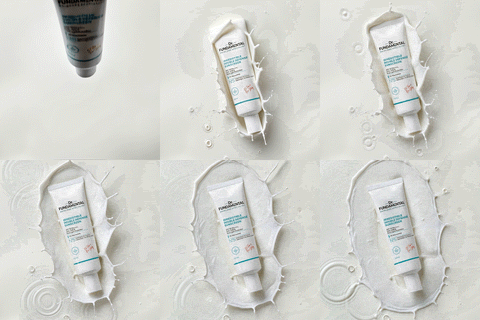
The Dr. Fundamental N0.2 Glass Skin Anti Acne Serum is built for exactly this. It brings together 2% Salicylic Acid, 5% Niacinamide, and 5% Azelaic Acid in a single lightweight, non-comedogenic formula designed specifically with acne-prone Indian skin in mind.
This is a serum for acne scars that doesn't stop at just brightening — it treats the full cycle. The encapsulated Salicylic Acid works inside your pores to clear blackheads and whiteheads without over-stripping your skin. The Niacinamide steps in to control oil, calm inflammation, and begin fading marks. The Azelaic Acid targets bacteria, reduces redness, and works on pigmentation simultaneously. Three actives, one bottle, and a formula that's also fragrance-free and dermatologically tested.
The clinical results back this up too — 93% of users found it effective in reducing acne scars and inflammation, and 89% saw improvement in acne marks and uneven skin tone. At ₹549, it's the kind of product that makes you wonder why you spent three times the amount on something that gave you half the results.
If you're looking for a serum for acne marks that also keeps new breakouts from forming, this is a genuinely smart addition to your routine — especially if you pair it with the N0.3 Clarifying Face Serum (which contains 4% Tranexamic Acid + 10% Niacinamide) for tackling deeper pigmentation and melasma. Together, they cover every stage of the acne-to-pigmentation pipeline.
How to Build Your Routine the Right Way
Getting the ingredient order right matters more than most people think. A thoughtfully layered routine will give you significantly better results than throwing everything on at once and hoping for the best.
For your morning routine, start with a gentle face wash, apply your anti acne face serum while skin is still slightly damp, follow with a lightweight moisturiser, and finish with SPF 30 or higher. Sunscreen isn't optional here — UV exposure will actively deepen any existing dark marks, so it's the one step you genuinely cannot skip.
For your evening routine, cleanse, apply your serum again (start with once daily and build up to twice as your skin adjusts), then moisturise. If you're also using a brightening or clarifying serum for pigmentation, layer the lighter-textured serum first and the richer one second.
One important note: don't try to layer Salicylic Acid products with retinol or other AHA/BHA peels without professional guidance — it's a recipe for over-exfoliation and a compromised skin barrier.
So, Tranexamic Acid vs Vitamin C — Final Verdict?
For Indian skin that's dealing with post-acne marks, recurring breakouts, and stubborn pigmentation — Tranexamic Acid is the more targeted, more reliable choice. It's gentler, it's more specific to the kind of pigmentation Indian skin tends to produce, and it doesn't come with the stability and irritation concerns that Vitamin C often brings.
But if you want the full package — clear skin, no new breakouts, faded marks, and a brighter complexion — you need to address the acne at its source too. That means a proper serum for blackheads, a formula that controls oil, and something that works consistently without destroying your barrier.
Vitamin C has its place. Tranexamic Acid deserves more credit than it gets. And a well-formulated, multi-active serum for acne scars that handles the whole cycle? That's the real skincare secret nobody talks about enough.
Your skin isn't high-maintenance. It's just been waiting for the right routine.