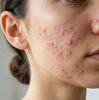
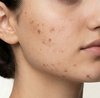
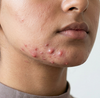


You cleared the breakout. But the dark spot it left behind? Still very much there — staring back at you every morning.
This is the reality for millions of people dealing with acne marks, and the frustrating part is that most skincare advice skips the why entirely. Why do some marks fade in weeks while others overstay for months? Why does one ingredient work brilliantly while another does nothing?
The answer lies in understanding what actually happens beneath your skin after a pimple heals — and knowing exactly which stage needs which support.
First, Let's Get This Straight: Acne Marks ≠ Acne Scars
This confusion costs people money, time, and results.
Acne scars are structural — they physically alter the texture of your skin (think pitted or raised skin). Acne marks, on the other hand, are flat, discoloured patches left behind by inflammation. They are changes in pigmentation, not in skin architecture. This means they can be treated effectively with the right topical ingredients.
The clinical term is Post-Inflammatory Hyperpigmentation (PIH) — and it's exactly what a well-formulated serum for acne marks targets.
The 3-Stage Recovery Process Your Skin Goes Through
Stage 1 — Inflammation & Damage Control (Days 1–7)
The moment your skin experiences a breakout, it triggers an immune response. Blood vessels dilate, immune cells rush in to contain bacteria and debris, and the area becomes visibly red or swollen.
Here's where things go sideways for many skin types: during this inflammatory phase, signalling molecules (pro-inflammatory cytokines) also stimulate melanocytes — the cells responsible for producing melanin (skin pigment). This is your skin "protecting" itself, but it often results in excessive pigment production.
What happens to your skin: Redness, tenderness, active inflammation
What your skin needs: Anti-inflammatory support, no picking, no friction
Ingredient focus: Calming actives like centella asiatica, barrier-supportive ingredients
Stage 2 — Proliferation & Surface Repair (Days 7–21)
The breakout begins to flatten. Your skin starts rebuilding — new cells migrate to resurface the area, collagen production kicks in, and the wound technically "closes." But the excess melanin triggered in Stage 1 is still sitting in the upper and middle layers of your skin.
This is the phase where the dark spot becomes fully visible. The pimple is gone, but what's left behind is what most people call the "stain."
What happens to your skin: Surface heals, but pigment becomes apparent
What your skin needs: Gentle exfoliation to accelerate cell turnover, pigment-interrupting actives
Ingredient focus: Tranexamic acid, niacinamide, mild exfoliants (PHA/lactic acid)
Stage 3 — Remodelling & Fading (Weeks 3–12+)
In this final phase, your skin continues to repair itself underneath the surface. Collagen fibres reorganise, leftover pigment slowly disperses, and the mark gradually lightens. Without any actives supporting this process, natural fading can take 6 to 12 months or longer, especially in deeper skin tones where melanin production is naturally more active.
What happens to your skin: Slow, natural depigmentation
What your skin needs: Consistent melanin-suppressing ingredients, daily SPF (non-negotiable)
Ingredient focus: Tranexamic acid (sustained use), niacinamide, SPF 30+
Where Does Tranexamic Acid Actually Fit In?
Tranexamic acid has earned its place as one of the most evidence-backed ingredients for hyperpigmentation — and here's why it works differently from other brightening actives.
Most brightening ingredients (like vitamin C or kojic acid) work by inhibiting the enzyme that triggers melanin production. Tranexamic acid takes a different route: it blocks the communication between UV-damaged skin cells and pigment-producing melanocytes. In simpler terms, it stops the signal that tells your skin to keep making the dark pigment.
This mechanism makes it particularly effective at Stage 2 and Stage 3 of recovery — exactly when the dark mark has formed and your skin needs help clearing it efficiently.
|
Recovery Stage |
Primary Concern |
Tranexamic Acid's Role |
|
Stage 1 – Inflammation |
Redness, active pimple |
Limited (anti-inflammatory support) |
|
Stage 2 – Surface Repair |
Mark appears, cell turnover |
✅ High — interrupts melanin signalling |
|
Stage 3 – Remodelling |
Slow fading |
✅ High — sustained depigmentation |
Why the Combination of Tranexamic Acid + Niacinamide Works Better
Using tranexamic acid alone delivers results — but pairing it with niacinamide creates a compounding effect that most single-ingredient formulas can't match.
Niacinamide (Vitamin B3) works at a different point in the pigment pathway: it prevents melanin transfer from melanocytes to skin cells. So while tranexamic acid stops the production signal, niacinamide stops the pigment from spreading into the surface layer. Together, they address the same problem from two separate angles.
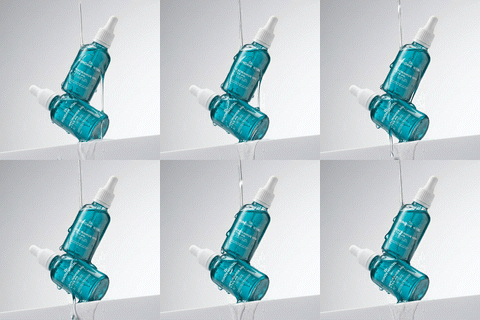
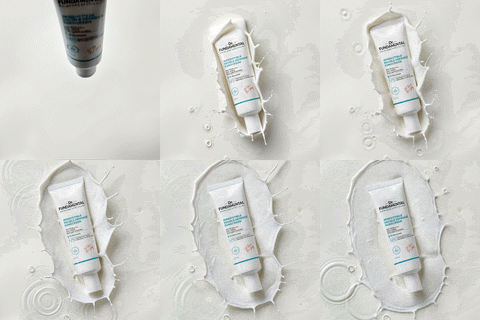
This is precisely what makes the DR. Fundamental 4% Tranexamic Acid + 10% Niacinamide Clarifying Face Serum a well-thought-out formula. The 4% concentration of tranexamic acid is clinically relevant without being irritating, while 10% niacinamide sits at the sweet spot shown to be effective across multiple skin concerns — including oil control, pore appearance, and skin barrier support.
If you're looking for a serum for acne scars and dark spots that doesn't compromise on skin tolerance, this combination is one of the most sensible you can use.
How to Use It Correctly for Best Results
Getting the formula right is half the job — using it correctly is the other half.
Morning routine:
Cleanse → DR. Fundamental Tranexamic Acid + Niacinamide Serum → Moisturiser → SPF 30 (mandatory)
Evening routine:
Cleanse → Serum → Moisturiser
Key rules:
- Apply to dry skin after cleansing for maximum absorption
- Do not layer with strong acids (AHAs/BHAs) in the same step — use them on alternate nights
- Sunscreen is not optional — UV exposure actively darkens existing PIH marks and reverses your progress
- Allow 8–12 weeks of consistent use for visible results; hyperpigmentation takes time
Who Needs This Serum the Most?
This product is specifically built for people dealing with:
- Recurring breakouts that keep leaving fresh marks before old ones fade
- Medium to deep skin tones where PIH tends to be more intense and long-lasting
- Oily or combination skin that struggles with post-acne congestion and uneven tone
- Anyone who's tried brightening creams and found them too heavy or ineffective
If you've been searching for a serum for pimples that works beyond the active breakout stage — addressing what's left behind — this is the category you should be investing in.
The Honest Truth About Timelines
No serum — however well-formulated — fades marks overnight. What a good serum for acne marks does is accelerate a process that would otherwise take your skin many more months on its own.
Realistic expectations:
- Weeks 2–4: Skin texture may improve; some early lightening
- Weeks 6–8: Noticeable reduction in the intensity of dark marks
- Weeks 10–12: Significant fading with consistent daily use and SPF
Patience is the ingredient every skincare formula still can't bottle. But pairing it with the right actives means you're not waiting blindly — you're working with your skin's biology, not against it.