



You blot your face three times before noon. You avoid moisturiser like it's the enemy. You've tried every mattifying product on the market — and yet, your skin still breaks out, still feels tight after cleansing, and still looks congested no matter what you do.
Here's what nobody told you: your skin might be oily and severely dehydrated at the same time.
This is not a contradiction. It's one of the most misunderstood conditions in skincare — and fixing it starts with one thing: understanding the difference between oil and water on your skin.
The Myth That's Damaging Your Skin
The belief that oily skin is automatically well-moisturised has caused an entire generation of people to skip the one step their skin actually needs. The logic sounds reasonable on the surface — if my skin is producing oil, it clearly has enough moisture, right?
Wrong.
Oil (sebum) and water (hydration) are two entirely different substances controlled by two completely separate systems in your skin. Sebum is produced by your sebaceous glands and forms a surface lipid film. Hydration refers to the water content inside your skin cells — what keeps them plump, flexible, and functional. One cannot replace the other. Your skin can produce excess sebum and still be critically low on water at the same time.
This is why a ceramide moisturizer isn't just for dry skin. It is, in fact, one of the most important steps for anyone with oily or acne-prone skin.
What Is Actually Happening Inside Dehydrated Oily Skin
To understand this properly, you need to know about a process called Transepidermal Water Loss — or TEWL. This is the constant, passive evaporation of water from your skin's surface into the surrounding air. It happens every minute of the day, regardless of your skin type.
A healthy, intact skin barrier slows this process down. The barrier is made up of skin cells held together by a lipid matrix — primarily composed of ceramides, fatty acids, and cholesterol. When this structure is intact, water stays locked inside the skin. When it's damaged or depleted, water escapes too quickly, and the deeper layers of your skin become water-deficient.
Here's where it gets important for oily skin: when the skin senses this water loss, it signals the sebaceous glands to produce more oil — in an attempt to compensate and seal the surface. The result is skin that looks oily on top but is genuinely parched underneath. You treat the oiliness with drying products. The barrier weakens further. TEWL increases. More oil is produced. The cycle repeats, and your skin never actually gets better.
The Habits Most Likely Causing This
|
Common Habit |
What It Does to Skin |
|
Using harsh foaming cleansers |
Strips ceramides and lipids from the barrier |
|
Skipping moisturiser to reduce shine |
Removes the occlusive layer, accelerates water evaporation |
|
Over-exfoliating with AHAs or BHAs |
Disrupts surface integrity, increases sensitivity and TEWL |
|
Using multiple drying acne treatments |
Aggressively depletes the barrier's lipid layer |
|
Air conditioning or indoor heating |
Pulls moisture from the air and your skin simultaneously |
|
Applying actives without barrier support |
No buffer means increased irritation and water loss |
Every one of these habits — common in oily skincare routines — directly damages the skin barrier and accelerates dehydration. The more aggressively you try to control oil without supporting the barrier, the worse the underlying dehydration becomes.
How to Know If Your Oily Skin Is Actually Dehydrated
Before reaching for any product, it helps to know whether dehydration is actually the issue. Here are the signs that are easy to miss:
- Skin feels tight, uncomfortable, or stiff after cleansing — even though it looks shiny within the hour
- Makeup settles into fine lines or breaks down quickly
- T-zone is oily but cheeks feel rough, dull, or flaky
- Skin looks congested and tired, not just shiny
- Breakouts increase when using acne treatments
- Redness or sensitivity that wasn't there before
If several of these sound familiar, you are very likely dealing with dehydrated oily skin — and the solution isn't more oil control. It's barrier repair.
What Your Skin Actually Needs: Barrier Repair First
Think of your skin barrier like a brick wall. The skin cells are the bricks, and the lipid mortar holding them together is made up of ceramides, fatty acids, and cholesterol. When this mortar erodes — due to harsh products, sun exposure, pollution, or over-exfoliation — the wall develops cracks. Water escapes through those cracks. Irritants, bacteria, and allergens get in. And your skin starts producing more oil to patch the damage the only way it knows how.
The fix is not to strip more oil. The fix is to rebuild the mortar.
This is exactly what a ceramide moisturizer does. It doesn't add oil to the skin. It replenishes the lipid molecules your barrier has lost, seals the gaps where TEWL occurs, and gives your skin the structural support it needs to hold water properly.
And for oily, combination, and acne-prone skin specifically — the formula matters enormously. A heavy cream designed for dry skin will feel suffocating and may clog pores. What oily skin needs is a lightweight, non-comedogenic barrier repair formula that hydrates without congesting.
Why DR. Fundamental's Barrier Repair Oil-Free Moisturizer Is Built for This
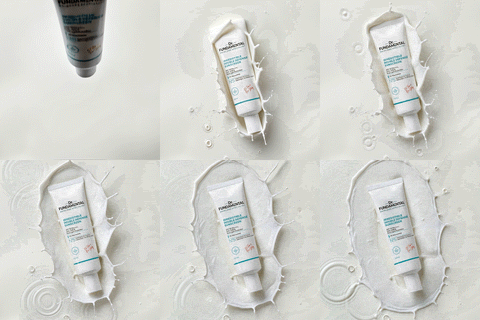
The DR. Fundamental Barrier Repair Oil-Free Moisturizer is formulated specifically around this problem. It is a ceramide moisturizer that goes beyond surface hydration — it works at the barrier level to repair, restore, and rebalance skin that has been caught in the oily-yet-dehydrated cycle.
Here's what makes it different from a standard moisturiser:
|
Key Ingredient |
What It Does |
|
Ceramide NP, AP & EOP |
Rebuilds the skin's natural lipid matrix; directly reduces TEWL |
|
5% Panthenol (Vitamin B5) |
Deep hydration + soothes active inflammation and redness |
|
Zinc PCA |
Regulates sebum production without stripping or drying |
|
Niacinamide |
Minimises pore appearance, improves skin tone, calms post-acne marks |
|
Cholesterol |
Works with ceramides to restore full barrier integrity |
Together, these ingredients don't just moisturise the surface — they rebuild the foundation. The Ceramide + Panthenol combination is particularly effective for reactive, post-treatment, and acne-prone skin because it soothes while it repairs, rather than causing further irritation.
This makes it one of the most effective options as a ceramide moisturizer, an oil-free moisturizer for combination skin, and the best winter moisturizer for acne-prone skin — all in a single, well-tolerated formula.
Why Winter Specifically Makes This Worse
If you have oily or acne-prone skin and you find that winters throw your skin completely off balance, this is exactly why. Cold air holds less moisture. Indoor heating reduces humidity further. And if you're living in North or Central India — cities like Delhi, Jaipur, Lucknow — winter air can be genuinely brutal on the skin barrier.
Add to this the tendency to use more active treatments in winter (retinoids, prescription acne creams) and you have a recipe for an extremely compromised barrier: dryness, sensitivity, breakouts, and paradoxically — more oil.
Using the best winter moisturizer for acne-prone skin during these months isn't optional. It's the difference between your skin staying in the reactive cycle all season or finally breaking out of it. A barrier-repair formula used consistently through winter gives your skin the structural support it needs to tolerate actives, regulate oil naturally, and stop the dehydration-oil loop from dominating.
How to Build the Right Routine Around It
Morning Routine:
- Gentle, non-stripping face wash — avoid anything that leaves skin feeling "squeaky clean"
- Hydrating toner or mist (optional but beneficial)
- DR. Fundamental Barrier Repair Oil-Free Moisturizer — apply evenly on clean skin, massage gently until absorbed
- Broad-spectrum SPF 30 or higher — always, every day, every season
Night Routine:
- Double cleanse if wearing SPF or makeup
- Active treatments — niacinamide serum, salicylic acid, or retinoid as needed
- DR. Fundamental Barrier Repair Oil-Free Moisturizer — apply a generous layer, especially on dry or reactive areas, as an overnight barrier treatment
One practical tip: if you use prescription acne treatments or strong actives at night, always apply this moisturiser as the final step. It acts as a buffer that reduces irritation and prevents the dryness that most people experience when using acne treatments long-term.
Real Results: What to Expect
The change doesn't happen overnight — but it happens faster than most people expect when the right product is used consistently.
- Within the first application: Skin feels immediately calmer, less tight, more comfortable
- Week 1–2: Reduction in redness and post-treatment irritation; skin starts to feel less reactive
- Week 2–3: Oil production begins to self-regulate as the barrier strengthens; breakouts from barrier-related sensitivity reduce
- Week 4 and beyond: Visibly smoother texture, more even skin tone, genuinely balanced oil levels
61% of users reported a measurable improvement in skin barrier feel within five minutes of first use. With consistent daily application, most report significantly reduced redness, dryness, and acne sensitivity within two to three weeks.
The Takeaway
Oily skin does not mean hydrated skin. If you've spent years fighting shine with drying products and skipping moisturiser — and your skin has never actually improved — dehydration is almost certainly part of the problem.
The answer isn't more oil control. It's a smarter approach: repair the barrier, restore the skin's ability to hold water, and let it regulate itself.
The DR. Fundamental Barrier Repair Oil-Free Moisturizer is a clinical-grade ceramide moisturizer that works as an oil-free moisturizer for combination skin, and doubles as the best winter moisturizer for acne-prone skin — without heaviness, without pore-clogging, and without compromising your acne routine.
Your skin isn't producing too much oil because it's naturally oily. It's producing too much oil because it's been dehydrated and under-supported for too long.
Give it what it actually needs. The results will follow.