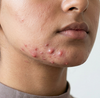



Okay, real talk. If you've been scrolling through skincare content lately — Instagram reels, Reddit threads, YouTube routines — you've probably noticed that everyone seems to be saying the same thing right now. Not "try this new acid." Not "this serum changed my life." The conversation in 2026 has shifted to something far more fundamental: skin barrier repair.
And before you roll your eyes thinking this is another overhyped skincare buzzword — just wait. Because if you have oily, combination, or acne-prone skin, this trend is literally about you. Possibly more than anyone else.
First, Let's Talk About What the Skin Barrier Actually Is
No jargon, I promise. Your skin barrier is the outermost layer of your skin — the part that faces the world every single day. Pollution, UV rays, harsh products, hard water, Indian summer heat — your barrier takes all of that on its behalf so the rest of your skin doesn't have to.
Structurally, think of it like a brick wall. Your skin cells are the bricks. The lipids — fats like ceramides, cholesterol, and fatty acids — are the mortar holding everything in place. When the mortar is intact, the wall holds. Moisture stays inside. Irritants stay outside. Your skin basically minds its own business in the best possible way.
But when that mortar breaks down? The wall starts crumbling. Moisture escapes. Irritants get in. Your skin becomes reactive, red, dehydrated, and weirdly more breakout-prone — even if it's already oily. Yep. Oily skin with a damaged barrier is absolutely a thing, and it's far more common than people realise.
So Why Is Everyone Suddenly Talking About This in 2026?
Here's the plot twist nobody asked for but honestly needed: years of "more active, more active, more active" culture has quietly damaged a lot of people's skin barriers. Retinols layered with acids layered with vitamin C layered with exfoliants — all used with the best intentions, and all slowly eroding the very foundation that makes skin healthy.
2026 is the year skincare collectively looked in the mirror and went, "okay, we may have overdone it a little."
The shift is happening across the board — from dermatology clinics to skincare communities to product formulations. People are moving away from correction and towards restoration. Instead of asking "what can I add to fix my skin faster," the question is now "what does my skin actually need to function well?" And the answer, almost always, starts with the barrier.
Skincare experts have been saying for a while that barrier repair is no longer a niche concern — it's the foundation of everything. Whatever your skin goal is — fading marks, controlling oil, clearing acne, getting that glow — none of it works as well if your barrier is compromised. Fix the foundation first. Everything else becomes easier.
But I Have Oily Skin. Does Any of This Actually Apply to Me?
Oh, it absolutely does. If anything, it applies more to you.
This is the biggest misconception in oily skin care: the idea that producing a lot of oil means your skin is well-hydrated and barrier-healthy. It doesn't. Oily skin and a healthy barrier are two completely separate things. Your skin can be pumping out excess oil on the surface while being internally dehydrated and structurally compromised underneath. And if you've ever been on an aggressive acne routine — strong cleansers, drying spot treatments, daily exfoliants — the chances are very high that your barrier has taken some hits.
The most telltale signs that your barrier is struggling, even on oily skin:
- Your skin feels tight and uncomfortable right after washing, but gets oily again within an hour
- Products that used to be totally fine now sting or irritate
- Post-acne marks are taking longer to fade than they used to
- You keep breaking out even when you're doing "everything right"
- Your skin just looks and feels inflamed a lot of the time
If any of this sounds familiar, your skin isn't being difficult. It's asking for help in the only language it knows.
Ceramides: The Ingredient at the Centre of It All
If 2026 has a skincare hero ingredient, it's ceramides. And they've absolutely earned that title.
Ceramides are lipids that are naturally produced in your skin. They make up roughly half of the skin's barrier structure, which means they're not a foreign ingredient your skin has to learn to accept — they're already part of the original formula. Your skin knows ceramides. It recognises them, uses them, and genuinely needs them.
The problem is that ceramide levels in the skin drop. Sun exposure causes it. Harsh cleansers cause it. Over-exfoliation causes it. Strong acne treatments cause it. Even just living in a polluted city causes it. And when ceramides deplete, the barrier weakens and everything starts going sideways.
Using a ceramide moisturizer is essentially your skin's version of a refill. You're restoring what was already there — not introducing something new, just topping up what's been lost. This is why ceramide-based formulas are consistently the top dermatologist recommendation for barrier repair. They work with the skin's own structure rather than trying to override it.
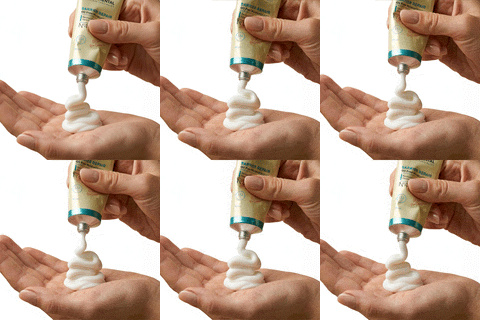
For oily skin specifically, the key is finding a ceramide moisturizer for oily skin that delivers the barrier benefits without the texture of a rich cream. The ceramide does the barrier work; the formulation ensures it doesn't sit heavy, feel greasy, or clog a pore in sight. That's the sweet spot — and modern formulations are genuinely nailing it.
The Moisturizer Fear That Oily Skin Has Lived With For Too Long
Let's be honest. Most people with oily or acne-prone skin have spent years either avoiding moisturizer entirely or using something so thin and watery it basically does nothing. The logic has always been: "my skin is already producing oil, why would I add moisture on top of that?"
And look — the intention makes sense. But the logic doesn't hold up.
Here's what actually happens when you skip moisturizer on acne-prone skin: your barrier, already stripped by cleansers and actives, gets no replenishment. It keeps losing water through the cracks. The skin panics. To compensate, oil production actually increases. You end up oilier than you would have been if you'd just moisturized. And on top of that, your actives — the benzoyl peroxide, the salicylic acid, the niacinamide serums — start irritating skin that has no barrier left to protect it.
It's a cycle that a lot of oily-skin people are stuck in, and the way out is almost always a well-formulated ceramide moisturizer for acne-prone skin. Not a heavy cream. Not an oil. A lightweight, non-comedogenic, fragrance-free formula that gives the barrier what it needs without smothering the skin.
A ceramide moisturizer for acne-prone skin doesn't fight your acne routine — it supports it. Think of it as the calm, sensible friend who keeps everyone in the group chat from going completely unhinged.
Why 5% Panthenol Is the Quietly Brilliant Ingredient in Barrier Repair
Ceramides get the spotlight, and rightfully so. But in 2026's barrier repair conversation, Panthenol — also called Provitamin B5 — is the ingredient doing serious behind-the-scenes work.
Panthenol is a humectant and skin-conditioning agent. When it's applied to the skin, it converts to Panthenic Acid, which is a molecule your skin cells already use naturally. It doesn't just sit on top of the skin adding temporary moisture — it actually penetrates, hydrates from within, and supports the skin's own repair mechanisms.
At a 5% concentration, which is a meaningful, clinically relevant dose, panthenol is especially effective for reactive and post-treatment skin. It soothes irritation, calms redness, and helps damaged skin recover significantly faster than it would on its own.
A 5% Panthenol moisturizer for acne-prone skin is particularly valuable when:
- Your skin is reacting to active acne treatments and feels raw or sensitive
- You have post-breakout redness and inflammation that won't settle down
- Dryness and flaking are showing up in patches on otherwise oily skin
- Your skin feels reactive to almost everything you try to put on it
What makes panthenol special in a barrier repair formula is that it doesn't just manage symptoms — it supports actual recovery. It's the difference between putting a plaster over the problem and helping the skin genuinely heal.
Zinc PCA: The Ingredient That Makes This Work for Oily Skin Specifically
Here's where the barrier repair story gets even more interesting for oily skin types. Because if ceramides are rebuilding the barrier and panthenol is soothing everything down, you need something to actually address the oil overproduction that's been causing chaos. Enter Zinc PCA.
Zinc PCA is a sebum-regulating ingredient. It works by moderating how much oil the sebaceous glands produce — which means it helps address the root cause of excess oiliness, not just blot it away temporarily. When you combine this with ceramides and 5% panthenol in one formula, you get something genuinely useful for oily, acne-prone skin: hydration, barrier repair, and oil control all in one step.
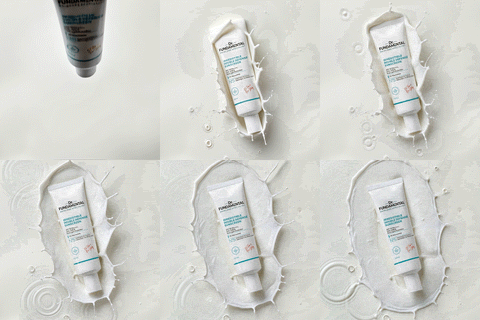
This exact combination — Ceramides NP, AP, EOP + 5% Panthenol + Zinc PCA — is what makes the Dr. Fundamental N0.4 Barrier Repair Oil-Free Moisturizer worth talking about. Each ingredient has a specific job. Nothing in the formula is decorative.
How to Actually Know If Your Barrier Is Damaged
Sometimes the skin sends signals we misread as "I need a stronger active" when what it's actually saying is "please stop and just let me heal." Here's a quick checklist of what a damaged barrier actually feels like:
- A stinging or burning sensation when applying products — even gentle ones — that never bothered you before
- Skin that feels tight, uncomfortable, or almost sore after cleansing
- Redness or flushing that appears without any obvious trigger
- Breakouts that heal slowly and leave dark marks much faster than they used to
- An overall feeling of your skin being "angry" — sensitive, reactive, never quite settled
You don't need all five. Even two or three is your skin asking for a different approach. The good news is that skin is genuinely good at healing when you stop working against it and start giving it the right support.
What a Barrier-Smart Routine Actually Looks Like for Oily and Acne-Prone Skin
Barrier repair doesn't mean dismantling your entire acne routine. It means layering smarter so your actives do their job without destroying the skin they're supposed to be helping. In practice, a sensible routine for oily, acne-prone skin looks like this:
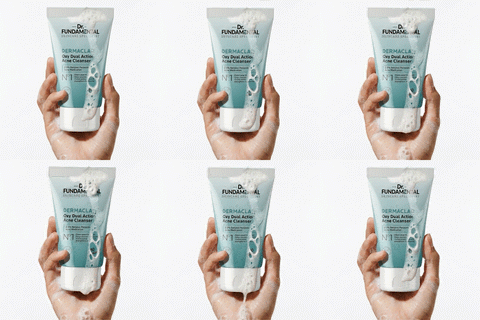
Start with a cleanser that does its job without stripping. A properly formulated acne cleanser removes excess oil and treats bacteria without leaving skin feeling scoured. Cleanse twice a day — morning and night — and not more than that.
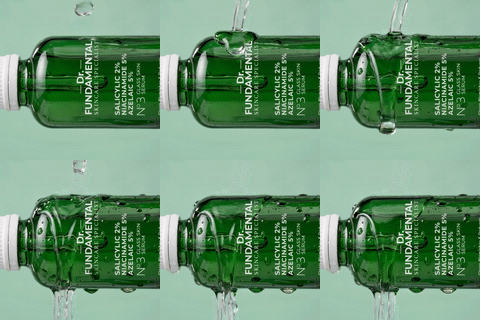
After cleansing, your active serums go on. Salicylic acid clears pores. Niacinamide regulates oil and calms inflammation. Tranexamic acid fades post-acne marks. These are your treatment steps and they do genuinely important work.
Then — and this is the step oily skin skips most — moisturizer. A ceramide moisturizer for oily skin goes on after your actives. This is the step that makes the whole routine sustainable. It replenishes what the actives have stripped, supports the barrier so it doesn't become reactive, and keeps the skin balanced rather than tight or over-stripped.
Finally, sunscreen in the morning. Always, without exception. UV damage is one of the most consistent external causes of barrier breakdown, and no barrier repair routine is complete without protection. An SPF 50 PA++++ formula that sits lightly on oily skin is the finish line of your morning routine.
What to Look for in a Ceramide Moisturizer for Oily and Acne-Prone Skin
Not every ceramide moisturizer is the right one for oily skin. The ingredient list matters, but so does the formulation. Here's what actually makes a ceramide moisturizer work for this skin type:
- Oil-free and non-comedogenic — non-negotiable. You want barrier repair without any pore congestion
- Lightweight texture — gel-cream or lotion formats absorb properly and don't interfere with the rest of the routine
- Fragrance-free — fragrance is a common cause of sensitivity and ironically one of the things that damages the barrier it's supposed to be in
- Meaningful ceramide content — ceramides listed high on the ingredient list, not buried at the bottom as a label claim
- Layers well under sunscreen — it shouldn't pill, ball up, or create a heavy base that makes SPF application a nightmare
The Dr. Fundamental Barrier Repair Oil-Free Moisturizer genuinely meets all of these. It's fragrance-free, dermatologically tested, non-comedogenic, and contains three types of ceramides — NP, AP, and EOP — which work together to repair the barrier more comprehensively than a single ceramide type. Real-user clinical results showed 61% felt relief from barrier discomfort within 5 minutes, 97% saw reduced dryness and improved skin feel with consistent use, and 84% experienced reduced post-acne redness without any pore congestion. At ₹550 for 50ml, it is genuinely excellent value for a formula this well-considered.
The Habits That Are Quietly Damaging Your Barrier Every Day
Since we're being honest with each other, let's talk about the common mistakes that keep oily-skin people stuck in the barrier-damage cycle:
- Over-cleansing — washing your face more than twice a day strips the skin's natural lipids every single time. More washing does not mean cleaner skin; it means more barrier damage.
- Skipping moisturizer — as we've established, this doesn't reduce oiliness. It actually makes oil production worse and leaves skin more vulnerable to irritation.
- Layering too many actives at once — your skin can only process so much. Rotating actives smartly is always better than stacking everything at once.
- Using alcohol-heavy toners — these feel like they're controlling oil but they're actually stripping the barrier, which triggers even more oil in retaliation.
- Going without sunscreen — UV radiation quietly and consistently erodes the skin barrier every time you step outside unprotected.
If you've been doing some of these — no judgment at all, most of us have. The point is just to understand why the skin has been struggling, so the solution makes more sense.
The Bigger Picture: From "Fix My Skin" to "Support My Skin"
This is genuinely the most important part of the whole barrier repair conversation, and it's not about an ingredient — it's about a mindset.
For years, especially those with oily and acne-prone skin, the approach has been adversarial. Treat the skin like an enemy that needs to be brought under control. Every breakout is a battle. Every oily patch is a problem to be dried up. The default response is always to add something stronger, something more aggressive, something that will force the skin into submission.
But 2026's skincare conversation is asking us to flip this completely. Your skin is not the enemy. It's a barrier that has been fighting on your behalf, often without the support it needs. When you stop trying to punish it into behaving and start giving it what it actually needs — ceramides to repair the structure, a 5% Panthenol moisturizer for acne-prone skin to soothe and recover, oil control that doesn't strip, and SPF to protect — the skin stops fighting back and starts functioning properly.
That's what barrier repair actually means. Not a step in your routine. A complete reframe in how you think about your skin.
To Sum It All Up
Skin barrier repair is the biggest skincare trend of 2026 because it's the correction a generation of over-actived skin desperately needed. And for oily, acne-prone skin specifically, it's not just a trend to follow — it's the thing that will finally make your whole routine make sense.
A proper ceramide moisturizer for acne-prone skin, with a real dose of panthenol and a non-comedogenic, oil-free formulation, isn't a compromise for oily skin. It's the smarter choice. It's what finally breaks the cycle of strip → reactive → oily → breakout → strip again.
Your skin isn't too oily for moisturizer. It's not too acne-prone for ceramides. It just needs the right formula — and it's been waiting for you to find it.