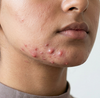



You survived the 42°C Indian summer. You ran home, cranked the AC to 18°C, and exhaled. Pure bliss. But while you're sitting in that gloriously cold room feeling like royalty, your skin? It's quietly having a meltdown. Not the dramatic kind — the sneaky, slow-burn kind that leaves you wondering why your face suddenly feels tight, looks dull, and keeps breaking out even when you haven't changed a single thing in your routine.
Spoiler alert: your AC is doing more than just cooling your room. It's silently destroying your skin barrier every single day — and what you actually need is a ceramide moisturizer that works as a proper moisturizer for oily acne prone skin. Most of us have absolutely no idea this is even happening.
What Even Is the Skin Barrier (And Why Should You Care)?
Let's start from the beginning because this part actually matters. Your skin barrier — also called the stratum corneum — is the outermost layer of your skin. Think of it like a brick wall. Your skin cells are the bricks, and the lipids (ceramides, cholesterol, fatty acids) in between them are the mortar. When the mortar is intact, your wall is strong. Moisture stays in, and bacteria, pollution, and irritants stay out.
Now imagine someone slowly chipping away at that mortar every single day, quietly, without making much noise. That's exactly what air conditioning does to your skin barrier.
Here's the Science Behind It (Don't Worry, We'll Keep It Friendly)
Air conditioners work by removing humidity from the air. That's literally the mechanism — they cool the room by pulling moisture out of it. And when the surrounding air is dry, it starts pulling moisture from any available source. Unfortunately, one of those sources is your skin.
This process is called Transepidermal Water Loss, or TEWL. It's just a fancy way of saying water is evaporating from your skin's surface faster than it should. When TEWL is consistently high — which it is when you're sitting in an AC room for 8+ hours a day — your skin barrier starts to break down. The lipid matrix between your skin cells becomes disorganized, creating tiny microscopic gaps. And through those gaps, moisture keeps escaping while irritants and bacteria creep in.
The result? A vicious cycle that's really hard to break once it starts.
The Signs Your AC Is Already Damaging Your Skin Barrier
Here's the thing — these signs are easy to dismiss because they don't scream "damaged barrier." They whisper it. Very casually. Over weeks and months.
Your skin may feel inexplicably tight after cleansing, even though you're using the same gentle facewash you've been using for months. You might notice a light sting when you apply your serum — something that never used to happen. Small patches of redness might appear, or your skin might feel rough to the touch by evening even though you moisturized in the morning. And if you're acne-prone, you might be breaking out more frequently and wondering what on earth you changed in your diet.
The answer is: you didn't change anything. Your skin barrier changed. And AC is almost certainly a major culprit.
Wait — Can AC Really Cause More Acne?
Yes, and this is the part that surprises most people. Here's how it actually works.
When your skin loses moisture and the barrier weakens, your sebaceous glands (the ones that produce oil) panic. They sense dryness on the surface and respond by producing more sebum to compensate. More sebum means more clogged pores. More clogged pores means more breakouts. All of this is happening while your skin is simultaneously becoming more sensitive and less able to defend itself against acne-causing bacteria.
So you end up with the absolute worst combination: oily on the surface, dehydrated underneath, and a barrier that's too weak to do its job. It's why so many people with oily or combination skin still experience dryness, tightness, and sensitivity — especially if they spend most of their day indoors in air-conditioned environments.
The AC + Indian Skin Problem Is Extra Real
If you're in India — particularly in cities like Delhi, Jaipur, Mumbai, or Hyderabad — you're dealing with a very specific kind of skin stress. You step outside into 40°C heat and humidity, your skin adjusts. You walk into an office or mall that's blasting AC at 18°C, your skin adjusts again. Back outside, then back inside. This constant fluctuation between extreme heat and extreme dryness is a compound stressor on your barrier that doesn't get talked about enough.
Your skin barrier was not designed to toggle between environments this different, this frequently, every single day. Over time, this daily temperature and humidity shock speeds up barrier degradation significantly — which explains why many people notice their skin getting more reactive and unpredictable as summers progress, even without changing a single product.
What Happens If You Ignore This for Too Long?
It doesn't stay subtle forever. When barrier damage goes unaddressed, here's what can happen over time:
- Your skin becomes increasingly reactive to products it previously tolerated fine — serums, acids, even gentle cleansers suddenly feel like they're burning.
- Breakouts become more frequent and take longer to heal because the skin's natural repair process is impaired.
- Redness and inflammation start showing up more consistently, not just occasionally.
- Post-acne marks take longer to fade because a compromised barrier means slower skin cell turnover.
- Fine lines and dullness creep in faster because dehydrated skin always looks older than it actually is.
This is not dramatic exaggeration — this is a slow domino effect that begins with something as ordinary as sitting in a cool office for eight hours a day.
So What's the Fix? (This Is the Part You Actually Came For)
The good news is that barrier repair is completely possible. The key is knowing which ingredients actually do the job — and choosing a product that works with your skin type, not against it. This is especially important if you have oily, combination, or acne-prone skin, because most barrier repair products on the market are rich, heavy, and frankly terrifying to anyone who's ever dealt with breakouts.
The ingredients you want to look for in your moisturizer are ceramides, panthenol, and zinc PCA. Here's a quick breakdown of why each of these matters so much:
- Ceramides are the exact lipids your skin loses when the barrier is damaged. Replenishing them from the outside literally rebuilds the mortar in your brick wall. Research consistently shows that acne-prone skin has naturally lower ceramide levels than balanced skin, which is why an external ceramide moisturizer is non-negotiable — not optional.
- Panthenol (Vitamin B5) is one of the most well-tolerated barrier-repair ingredients in skincare. It attracts moisture, supports the skin's healing process, and reduces the feeling of tightness and irritation. A 5% Panthenol moisturizer for acne prone skin is particularly effective because it provides serious hydration without adding oil or triggering breakouts.
- Zinc PCA is the bonus ingredient that makes this combination work especially well for oily and acne-prone skin — it actively regulates sebum production, so your skin doesn't go into oil-overcompensation mode every time the AC strips it dry.
Why Oily Skin Specifically Cannot Skip Moisturizer in AC Environments
This is one of the most persistent myths in skincare, and it needs to be put to rest. Oily skin is not the same as hydrated skin. You can have an oily face and still be deeply dehydrated underneath — and this is extremely common in AC-heavy environments.
When you skip moisturizer, your skin loses water faster, the barrier weakens more quickly, and oil production actually increases as compensation. Skipping moisturizer in an attempt to control oiliness is quite literally making the problem worse. The solution isn't less moisture — it's the right kind of moisture. That means an oil-free moisturizer for combination skin that hydrates without adding grease, clogging pores, or making your face look like a frying pan by noon.
Meet the Moisturizer That Actually Gets This Right
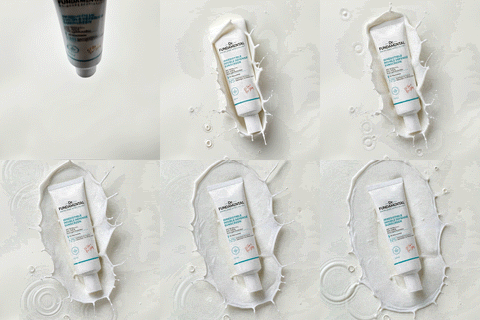
The Dr. Fundamental Barrier Repair Oil-Free Moisturizer was formulated with exactly this problem in mind. It combines Ceramide NP, AP, and EOP (the three most important ceramide types for barrier repair), 5% Panthenol, and Zinc PCA in a completely oil-free, non-comedogenic, fragrance-free base. It's light enough to wear under sunscreen every morning, but effective enough to genuinely repair a damaged barrier over time.
This is a proper ceramide moisturizer for everyone sitting in AC for hours daily — students, working professionals, anyone whose skin has been quietly suffering through the summer — and it's specifically designed as a moisturizer for oily acne prone skin that wants barrier repair without the breakout.
The clinical results are pretty compelling too. 61% of users felt relief from tightness and barrier discomfort within just five minutes of applying it. 97% noticed improved skin elasticity and reduced dryness after consistent use. And 84% saw reduced post-acne redness — which makes sense, because when your barrier is functioning properly, your skin is simply better at everything, including healing.
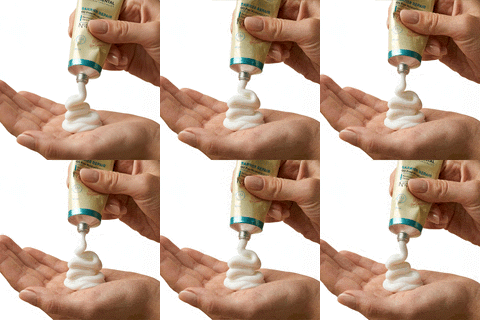
It goes on after your serum and before your SPF in the morning, and can be used as your final step at night as well. On days when your skin feels particularly stressed — think: long hours in heavy AC, back-to-back temperature changes, or right after a strong actives routine — you can apply a slightly more generous layer on tight or irritated areas.
The Non-Skincare Things That Also Help
While your moisturizer is doing the heavy lifting, a few lifestyle habits make a real difference when you're spending a lot of time indoors.
Drink water consistently throughout the day — not just when you remember. Keep a small humidifier near your desk if possible, especially if your office or room is aggressively air-conditioned. Try to avoid over-cleansing; stripping your skin multiple times a day makes barrier damage significantly worse. And always, always wear SPF during the day, because UV damage is another major barrier stressor that compounds with everything else.
Think of it as a team effort: your moisturizer handles the repair, your lifestyle habits reduce how much damage is happening in the first place.
Your Quick Anti-AC Skin Barrier Routine
If you're starting from scratch, here's a simple approach that actually works:
- Cleanse once or twice daily with a gentle, pH-balanced cleanser — nothing stripping.
- Apply your active serums (salicylic acid, niacinamide, or whatever you're using for acne) on clean skin.
- Follow immediately with a 5% Panthenol moisturizer for acne prone skin that contains ceramides to seal in the actives and protect the barrier.
- Finish with SPF in the morning. Every single morning. No exceptions.
- At night, apply a slightly more generous layer of your ceramide moisturizer as the last step.
That's genuinely it. The key is the consistency — your barrier didn't break down in a week, and it won't rebuild in a week either. But with the right ingredients used regularly, most people notice a meaningful difference within two to three weeks.
The Bottom Line
Your air conditioner is not the villain — it's just doing its job a little too well, and your skin is paying the price. The solution isn't to sweat through summer (absolutely not), it's to understand what's happening and give your skin what it actually needs: consistent barrier repair with ceramides, panthenol, and the right kind of hydration for your skin type.
If your skin has been feeling more reactive, more oily, more breakout-prone, or just generally off since the AC season started — this is almost certainly why. And now you know exactly what to do about it.