






If you have ever stared at a stubborn dark spot on your cheek or that annoying acne mark that simply refuses to leave — you are not alone. For Indian skin, pigmentation is one of the most persistent and emotionally draining concerns. The skincare world gives you two popular solutions: tranexamic acid and Vitamin C. Both are celebrated brighteners. But are they actually the same? And more importantly, which one is doing the real heavy lifting for your skin?
Let us break this down — clearly, honestly, and without the fluff.
Why Indian Skin Behaves Differently with Pigmentation
Indian skin sits in the Fitzpatrick III–V range — meaning it has more active melanocytes (the cells responsible for producing melanin). This is a beautiful thing. But it also means that any trigger — sun exposure, acne, heat, hormonal shifts — causes the skin to overproduce melanin faster and more aggressively than lighter skin tones.
The result? Post-acne marks that linger for months. Melasma that laughs in the face of regular brightening creams. Uneven patches that no amount of foundation can fully cover.
This is exactly why the ingredient you choose for dark spots matters far more than how regularly you apply it.
What Is Tranexamic Acid — And Why Is It Suddenly Everywhere?
Tranexamic acid (TXA) was originally developed as a medical compound to control excessive bleeding. In the process, researchers discovered something fascinating: patients using it also reported clearer, more even-toned skin. That accidental finding changed skincare forever.
Unlike acids such as glycolic or salicylic acid, tranexamic acid does not exfoliate the skin. Instead, it works deeper — at the cellular communication level. It interrupts the signal between keratinocytes (skin surface cells) and melanocytes, effectively telling your skin to stop producing excess melanin before it even starts.
For Indian skin that is constantly being triggered by heat, pollution, hormonal fluctuations, and the aftermath of acne — this upstream approach makes tranexamic acid incredibly effective. It is a specialist ingredient, not a generalist.
What Does Vitamin C Actually Do?
Vitamin C is a powerhouse antioxidant. It neutralises free radicals caused by UV radiation and pollution, supports collagen production, and gently inhibits tyrosinase — the enzyme responsible for melanin synthesis. These properties give it a dual role: it protects against future pigmentation while slowly fading existing discolouration.
However, Vitamin C has real limitations for Indian skin conditions:
- It oxidises quickly in heat and humidity — both of which are unavoidable in India
- Higher concentrations (above 15%) can cause irritation or redness on reactive skin
- It works more effectively on early-stage pigmentation and overall dullness than on deep-set or post-inflammatory dark spots
In short, Vitamin C is a brilliant daily glow booster, but it is a generalist. When it comes to stubborn acne marks and deeply embedded hyperpigmentation, it often falls short on its own.
Head-to-Head: Tranexamic Acid vs Vitamin C
|
Feature |
Tranexamic Acid |
Vitamin C |
|
Primary Action |
Blocks melanin production signals |
Antioxidant + mild melanin inhibitor |
|
Best For |
Melasma, PIH, stubborn acne scars |
Dullness, early pigmentation, glow |
|
Stability |
Very stable in most formulas |
Oxidises quickly in heat/humidity |
|
Skin Tolerance |
Excellent — even for sensitive skin |
Moderate — can irritate at high % |
|
Speed of Results |
Gradual but consistent |
Visible glow fast; pigmentation is slower |
|
Indian Skin Suitability |
⭐⭐⭐⭐⭐ |
⭐⭐⭐ |
|
Best Time to Use |
Morning or night |
Morning (with SPF) |
The Real Difference: Reactive vs Proactive
Here is the analogy that makes it click:
Vitamin C is like a security guard who reports damage after it happens. Tranexamic acid is the alarm system that prevents the damage from happening in the first place.
For a skin type that reacts to everything — a forgotten sunscreen, a late period, a week of street food — you need that alarm system. You need something that controls the pigmentation response before it becomes a blemish on your face.
This is not to say Vitamin C is useless. It is fantastic at protecting against environmental damage and giving your skin that morning lit-from-within quality. But when your concern is specifically serum for acne marks, serum for acne scars, or hormonal dark patches — tranexamic acid is the ingredient doing the actual corrective work.
What Happens When You Combine Tranexamic Acid with Niacinamide?
This is where things get genuinely exciting for Indian skin. Tranexamic acid already disrupts melanin production at the source. When paired with niacinamide, the duo creates a two-pronged attack:
- Tranexamic acid blocks the signal that overproduces melanin
- Niacinamide prevents melanin transfer from the melanocyte to the surface skin cells
Together, they address pigmentation from two different points in its journey — making the combination significantly more effective than either ingredient alone. Niacinamide also reduces redness, balances sebum, and strengthens the skin barrier, which makes this pairing particularly suited to oily, acne-prone Indian skin types.
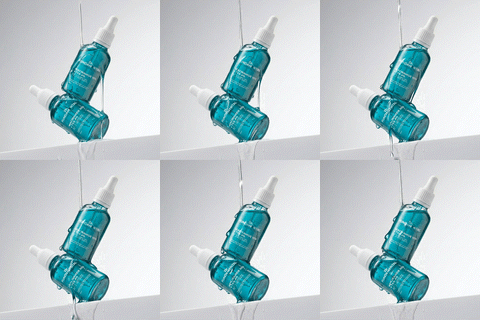
This is precisely why Dr. Fundamental's 4% Tranexamic Acid + 10% Niacinamide Clarifying Face Serum is formulated the way it is — not just to brighten, but to actively prevent and correct, while keeping skin calm and balanced throughout
Who Should Use Tranexamic Acid?
You are the right candidate for a blemish serum with tranexamic acid if:
- You deal with post-acne dark spots that stay long after the pimple is gone
- You have melasma or hormonal pigmentation around the cheeks and upper lip
- Your skin reacts badly to Vitamin C, retinol, or exfoliating acids
- You have tried general brightening products without meaningful results
- You have oily, combination, or sensitive skin prone to inflammation
How to Use It Right
- Cleanse your face and pat dry
- Apply 2–3 drops of the tranexamic acid serum onto your face and neck
- Let it absorb fully — approximately 60 seconds
- Follow with moisturiser
- In the morning, always finish with a broad-spectrum SPF 30 or higher
Without SPF, no brightening ingredient — including tranexamic acid — can do its job fully. Sunscreen is non-negotiable.
The Verdict for Indian Skin
If you are choosing between the two:
- Choose Vitamin C if your primary concern is daily glow and antioxidant protection against pollution and sun
- Choose tranexamic acid if your concern is stubborn dark spots, acne marks, melasma, or post-inflammatory hyperpigmentation
For most Indian skin types, the ideal routine is not a competition — it is a collaboration. Use Vitamin C in the morning alongside your SPF, and use a tranexamic acid + niacinamide blemish serum at night to actively repair and correct.
The spots that have been living rent-free on your face for months? They are not permanent. They just need the right ingredient — one built for Indian skin, not just good skin.