





Let's be real — Indian weather doesn't go easy on your skin. Between April's scorching dry heat, the thick humidity of July, and the unpredictable October showers, your sunscreen has to work overtime every single day. And somewhere in that chaos, most of us are picking up products with labels that say "sweat-proof" or "water-resistant" without really knowing the difference.
So which one actually holds up on your skin when the temperature hits 42°C or the monsoon humidity makes your face feel like it's wrapped in a damp cloth? Let's break it down — properly.
The Indian Weather Problem Nobody Talks About
Most sunscreens sold globally are made for temperate climates. They're tested in environments where sweating is minimal, humidity is manageable, and UV exposure is seasonal. India is none of that.
Here, UV radiation is aggressive year-round. UVA rays — the ones responsible for pigmentation, melasma, and premature ageing — don't take a break just because it's cloudy during monsoon. Meanwhile, the combination of heat and humidity triggers your skin to produce more sebum and sweat simultaneously. When that oil-sweat mix sits under a poorly formulated sunscreen, it breaks down the SPF film, leaving your skin exposed and your pores clogged.
This is exactly why choosing between sweat-proof and water-resistant isn't just a marketing exercise — it's a skin health decision.
Sweat-Proof vs Water-Resistant: What's Actually Different?
Many people use these terms interchangeably. They shouldn't.
|
Feature |
Sweat-Proof |
Water-Resistant |
|
Primary Design |
Withstands perspiration |
Withstands water immersion |
|
Testing Standard |
Physical activity & sweat |
40 or 80 minutes in water |
|
Film-Forming Ability |
High (uses polymers/silicones) |
Moderate to high |
|
Best For |
Outdoor commutes, sports, heat |
Swimming, rain, monsoon days |
|
Reapplication Needed? |
Yes, every 2 hours |
Yes, every 2 hours |
|
Texture |
Usually gel or fluid |
Gel, fluid, or cream |
The key takeaway? Neither is permanent. Both require reapplication. And in India's climate, you actually want a formula that combines both properties — something that handles sweat on your morning commute and doesn't wash away during unexpected rain.
Why Indian Skin Specifically Needs Something Smarter
Indian skin tones — ranging from wheatish to deep brown — have higher melanin, which provides some natural protection but also makes skin more prone to post-inflammatory pigmentation, uneven tone, and stubborn tan. A sunscreen that slides off by 11 AM isn't just cosmetically annoying; it's actively letting UV damage accumulate on skin that's already more vulnerable to discolouration.
Add to this the fact that many Indians live in cities like Delhi, Mumbai, Jaipur, and Chennai — where air pollution compounds UV damage by generating free radicals on the skin's surface. Your sunscreen needs to do more than block UV. It needs to stay put, keep skin calm, and ideally include ingredients that work with your skin biology.
The Ingredients That Actually Make a Difference
Forget the label. Flip the product over and look for these:
Niacinamide — This is a star ingredient for Indian skin and an absolute must if you're dealing with oiliness, enlarged pores, or pigmentation. A sunscreen with niacinamide regulates sebum production, strengthens the skin barrier, and helps fade dark spots over time. It also makes the formula feel lighter on skin, which matters a lot when humidity is already making you uncomfortable.
Film-forming polymers (like Acrylates Copolymer) — These are what make a sunscreen genuinely sweat-resistant. They form a flexible, breathable film on the skin that doesn't crack when you sweat or move.
Zinc Oxide (in hybrid formulas) — Works as a physical UV blocker and also has mild oil-controlling properties. When paired with chemical filters, it creates a broad-spectrum shield without the heavy white cast.
Hyaluronic Acid or Glycerin — Counterintuitive but important: dehydrated skin overproduces oil. A well-hydrated skin barrier actually stays less oily through the day. Lightweight humectants keep skin comfortable without greasiness.
Silica or Silicones — Absorb excess oil and give that smooth, matte finish that oily skin types desperately need during summer.
What Texture Should You Be Reaching For?
In Indian weather, texture matters as much as SPF number.
Gel or fluid textures are your best friends. They absorb in under 5 minutes, feel weightless, and don't create that "greenhouse" effect where sweat and product mix under a thick cream. A liquid sunscreen with a water-first formula is particularly suited for humid coastal cities and peak summer months.
Thick cream sunscreens — no matter how luxurious — tend to sit on the surface, trap sweat underneath, and eventually slide off. They're designed for dry, cold climates. In Indian heat, they're working against you.
The best approach for oily skin specifically: reach for a non comedogenic sunscreen in a gel or fluid form, with a stated water-resistance time (not just a vague "sweat-proof" claim with no numbers). A stated figure like 80 minutes tells you it's been tested. Without it, the claim means very little.
The Double Defence Approach: Why One Layer Isn't Enough
Here's something dermatologists frequently point out that most skincare content glosses over: application amount matters as much as formula.
The standard test dose for SPF is 2mg per square centimetre of skin. In practical terms, that's roughly two finger-lengths of product for your face and neck. Most people apply about 20–50% of that. When you under-apply, your actual SPF protection drops significantly — sometimes from SPF 50 to the equivalent of SPF 15 or less.
A smarter approach is what we call a double-defence strategy: a solid broad-spectrum sunscreen as your base, combined with sun-protective skincare actives underneath. Think niacinamide to control oil through the day, antioxidants like Vitamin C to neutralise free radicals, and a sunscreen that hydrates and protects simultaneously — so you're not just blocking UV but actively building your skin's resilience.
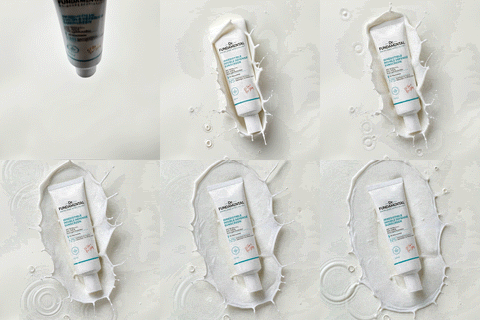
DR. Fundamental's Irresistible Double Defence Sunscreen is built exactly on this logic. It functions as both a liquid sunscreen with SPF 50 PA++++ and a skin treatment — combining the sweat-resistant staying power Indian weather demands with a sunscreen with niacinamide formulation that works on pigmentation, sebum control, and skin smoothness every day. It's a non comedogenic sunscreen specifically designed for Indian skin, which means it protects without triggering breakouts — a non-negotiable for best sunscreen for oily skin in India seekers.
Quick Reapplication Guide for Indian Weather
|
Situation |
Reapply Every |
|
Indoor office, AC environment |
3–4 hours |
|
Outdoor commute, moderate heat |
2 hours |
|
Active sweating, outdoor sports |
1–1.5 hours |
|
Monsoon / unexpected rain |
Immediately after wiping dry |
|
Post-swimming |
Immediately after towelling off |
The Bottom Line
Sweat-proof and water-resistant sunscreens are not the same, and in Indian weather, you ideally want both qualities in one formula. But beyond that label distinction, what your skin really needs is a non comedogenic sunscreen that's lightweight enough to actually wear daily, contains actives like sunscreen with niacinamide to address Indian skin concerns, and comes in a liquid sunscreen texture that survives humidity without clogging your pores.
Stop picking sunscreen based on SPF number alone. Start reading formulations, checking for water-resistance timing, and looking for products genuinely built for your climate — not imported from a country that sees sun three months a year.
Your skin puts up with a lot. Give it protection that keeps up.