





If you've been around skincare circles lately — Instagram, Reddit, YouTube — you've definitely come across the term skin cycling. And if you have oily, breakout-prone skin, you're probably wondering whether this routine is for you, and more importantly, where your beloved niacinamide serum for oily skin fits into the whole picture.
Here's the thing: skin cycling isn't just another passing trend. It's a structured, dermatologist-approved method of rotating your active ingredients so your skin can breathe, repair, and actually absorb what you're putting on it — rather than getting overwhelmed by too much, too soon.
Let's break it all down — simply, practically, and in a way that makes sense for acne-prone, oily Indian skin.
What Is Skin Cycling, Really?
Skin cycling is a 4-night rotating routine. Think of it less like a strict skincare rule and more like a smart schedule for your actives. Instead of layering every powerful ingredient every single night (which often leads to irritation, purging, or a broken barrier), you use them strategically — one night at a time.
<br>
|
Night |
What You Do |
Why |
|
Night 1 |
Exfoliation (BHA/AHA) |
Unclogs pores, removes dead cells |
|
Night 2 |
Retinoid/Retinol |
Speeds up cell turnover, fights acne |
|
Night 3 |
Recovery |
Barrier repair, hydration, niacinamide |
|
Night 4 |
Recovery |
More barrier love, calm ingredients only |
The cycle then simply repeats from night 5 onward. Simple? Yes. Effective? Absolutely — especially for skin that tends to freak out when actives are stacked without a plan.
Why Acne-Prone Skin Needs a Routine Like This
If your skin produces excess oil, clogs pores easily, and keeps throwing breakouts at you no matter what you try — the problem might not be your products. It might be how you're using them.
Using a retinoid, a BHA, and an exfoliant all in one night doesn't give your skin time to work with any of them. It just gets inflamed and irritated, and your barrier weakens — which ironically makes acne worse.
For oily or acne-prone skin, salicylic acid (BHA) penetrates pores and helps with congestion and is ideal for the exfoliation night, while consistent retinol use helps regulate sebum and prevent breakouts on the retinoid night.
Recovery nights — nights 3 and 4 — are where your niacinamide serum for oily skin enters the picture, and this is the part most people get wrong.
So, Where Exactly Does Niacinamide Fit?
Niacinamide is your recovery night hero — but it actually has a role on multiple nights, depending on how you build your routine.
On Recovery Nights (Night 3 & Night 4) — The Main Event
On recovery nights, the focus is on hydration and barrier repair using gentle, nourishing ingredients like ceramides, hyaluronic acid, and niacinamide.
After your skin has been through an exfoliation night and a retinoid night — both of which push your skin to work hard — the last thing it needs is another active. What it needs is calm, nourishment, and barrier support. And that's precisely what a well-formulated face serum for acne with niacinamide delivers.
Here's what niacinamide actually does during recovery:
- Regulates sebum production — so oiliness is managed without stripping
- Reduces post-inflammatory redness — calms the skin after active nights
- Minimises pore appearance — less visible pores = less congestion risk
- Strengthens the skin barrier — makes you r skin more resilient for the next cycle
- Fades post-acne marks (PIH) — the dark spots left behind after breakouts
In the window between weeks 4 to 6 of consistent niacinamide use, clearer-looking skin becomes more noticeable. Pore appearance begins to refine visibly as sebum regulation continues, and skin texture improves more meaningfully overall.
On the Retinoid Night — A Supporting Role
Some people with acne-prone skin use a niacinamide serum before their retinoid on night 2. This technique — called "buffering" — slightly cushions the retinoid's intensity for those whose skin is still building tolerance.
At night, when the skin is in its regenerative state, niacinamide works to repair and strengthen the skin barrier, soothe inflammation, and lock in moisture — making it a smart partner even when retinoids are involved.
In the Morning — Every Single Day
This is non-negotiable. Niacinamide can be used in both your AM and PM routine. A niacinamide serum is often water-based and lightweight — apply it after cleansing and toning, before your moisturiser. In the morning, it works as an oil-controller, pore-refiner, and a shield against the environmental damage your skin faces during the day.
The Power Pair: Azelaic Acid and Niacinamide
If you have acne-prone skin that also struggles with dark spots and post-acne pigmentation — which, honestly, most of us dealing with Indian skin conditions do — then the azelaic acid and niacinamide combination is the most underrated duo in your skincare arsenal.
Azelaic acid fights acne bacteria and unclogs pores, while niacinamide regulates oil and reduces inflammation. This combination is fantastic for managing acne-prone skin without the excessive dryness or irritation often associated with harsher treatments. Think of azelaic acid as the targeted treatment and niacinamide as the essential support system.
Here's how they divide responsibilities:
Azelaic Acid Does:
- Kills acne-causing bacteria
- Mildly exfoliates inside pores to clear out blackheads and whiteheads
- Inhibits melanin overproduction (great for PIH and dark spots)
- Reduces redness from active acne and rosacea
Niacinamide Does:
- Controls excess oil and shine
- Calms inflammation and redness
- Strengthens the skin barrier
- Fades existing post-acne marks
- Supports ceramide production for a plumper, healthier skin surface
Acne-prone skin benefits most from azelaic acid's antibacterial and pore-clearing action combined with niacinamide's oil-controlling and redness-reducing effects. Visible improvements in pore size and tone typically appear within 4 to 8 weeks of consistent use.
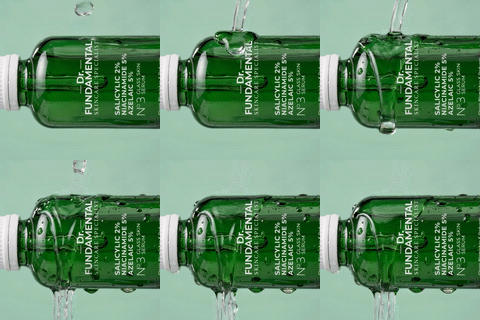
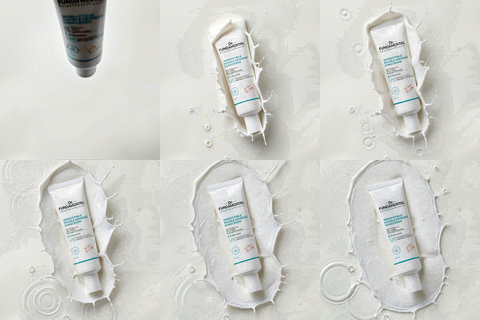
The DR. Fundamental Glass Skin Anti Acne Serum is formulated with exactly this philosophy — combining 5% Niacinamide, 5% Azelaic Acid, and 2% Encapsulated Salicylic Acid. It's a triple-action face serum for acne designed to clear, calm, and correct in one step — without the drama of harsh acids that wreck your barrier.
Your Skin Cycling Routine for Acne-Prone Skin — Step by Step
Here's how to build your cycle around your niacinamide serum for oily skin and the actives that work best for acne:
Night 1 — Exfoliation Night
For oily or acne-prone skin, BHA serum offers targeted pore-clearing action. Unlike AHAs that work on the surface, salicylic acid is oil-soluble, allowing it to penetrate into pores and address congestion from within — making it invaluable for anyone dealing with blackheads, enlarged pores, or regular breakouts.
- Gentle cleanser
- 2% Salicylic Acid (BHA) serum — your go-to serum for blackheads
- Lightweight, oil-free moisturiser
- Skip all other actives tonight
Night 2 — Retinoid Night
- Gentle cleanser
- Optional: thin layer of niacinamide serum as a buffer
- Retinol or adapalene (start low — 0.025% or 0.1%)
- Hydrating moisturiser with ceramides
Night 3 & 4 — Recovery Nights
- Gentle cleanser
- DR. Fundamental Glass Skin Anti Acne Serum (niacinamide + azelaic acid + salicylic acid)
- Gel-cream or barrier-repair moisturiser
- No actives. No exfoliants. Just calm.
Every Morning (All Days)
- Gentle cleanser
- Niacinamide serum (lightweight, water-based)
- SPF 30 or higher — non-negotiable
Common Mistakes Acne-Prone Skin Makes in Skin Cycling
Skipping recovery nights. This is the biggest one. People see progress and want to accelerate by exfoliating more. This always backfires. Recovery nights are where your skin consolidates the gains.
Using niacinamide only on recovery nights. You're leaving results on the table. Use it every morning too — it's gentle enough for daily use and it works as oil control throughout the day.
Mixing exfoliants and retinoids on the same night. Never mix retinoids with exfoliating acids on the same night — always apply products from thinnest to thickest consistency, and remember that less is often more when it comes to active ingredients.
Rushing through the cycle. Visible improvements take time — typically 4 to 8 weeks. Avoid rushing or adding products; skin cycling works best as a four-night regimen with only the necessary products.
Is Skin Cycling Right for All Acne-Prone Skin Types?
Mostly yes — but with one caveat. Oily or acne-prone skin can stick closer to the classic four-night cycle. Stronger actives like salicylic acid and adapalene can be incorporated, with fewer recovery days needed compared to sensitive or dry skin types.
However, if you have highly reactive skin, inflammatory cystic acne, or a severely compromised barrier, it's always worth talking to a dermatologist before diving in. Skin cycling is a smart framework, but personalization always wins.
Final Word
Skin cycling gives acne-prone skin exactly what it's been missing — a logical, structured, breathable routine where each ingredient actually gets to do its job. And in that cycle, niacinamide isn't just a supporting character. On recovery nights, it's the main act — calming, repairing, regulating, and fading the evidence of every breakout your skin has fought through.
Pair it with azelaic acid and niacinamide in a single, well-formulated face serum for acne, and you've got a routine that doesn't just manage acne — it transforms the skin underneath it.
Give your skin a rhythm. Give it a recovery. And give it a formula that works as hard as you do.
DR. Fundamental. Science-backed. Skin-approved.